
AI Voice Agents for Websites: Transform Customer Experience Through Voice
Discover how AI voice agents transform websites through natural conversations. Learn how businesses can automate customer support, answer visitor questions, improve accessibility, generate leads and deliver smarter customer experiences.
AicodePro Team
VERIFIED AUTHOR
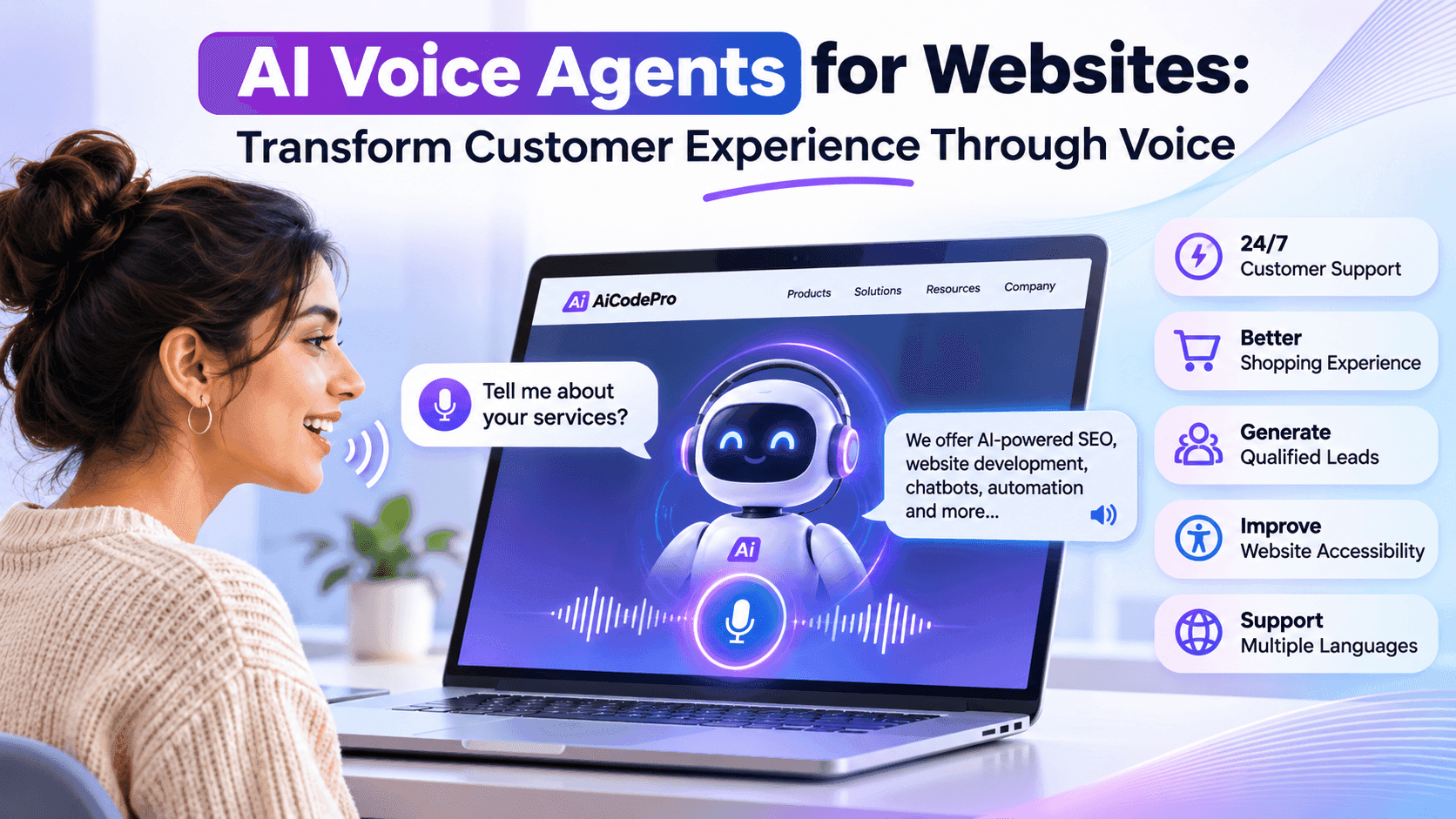
Imagine visiting a website and instead of searching through multiple pages, navigating menus, or typing questions into a chatbot, you could simply speak to it.
You ask a question, and the website responds instantly with relevant information, explains its services, answers your queries, and helps you find exactly what you are looking for.
This is the experience that AI Voice Agents for Websites are bringing to modern digital businesses.
Traditional websites are designed primarily for reading, clicking and typing. AI voice technology introduces another way for visitors to interact with a website: natural, conversational communication.
An AI Voice Agent can understand spoken questions, process them using AI, access relevant website knowledge, and respond with an AI-generated voice. Instead of making visitors search for information themselves, businesses can create a website experience where information comes directly to them through conversation.
With AI-powered voice agents, websites can become more interactive, accessible and responsive to customer needs.
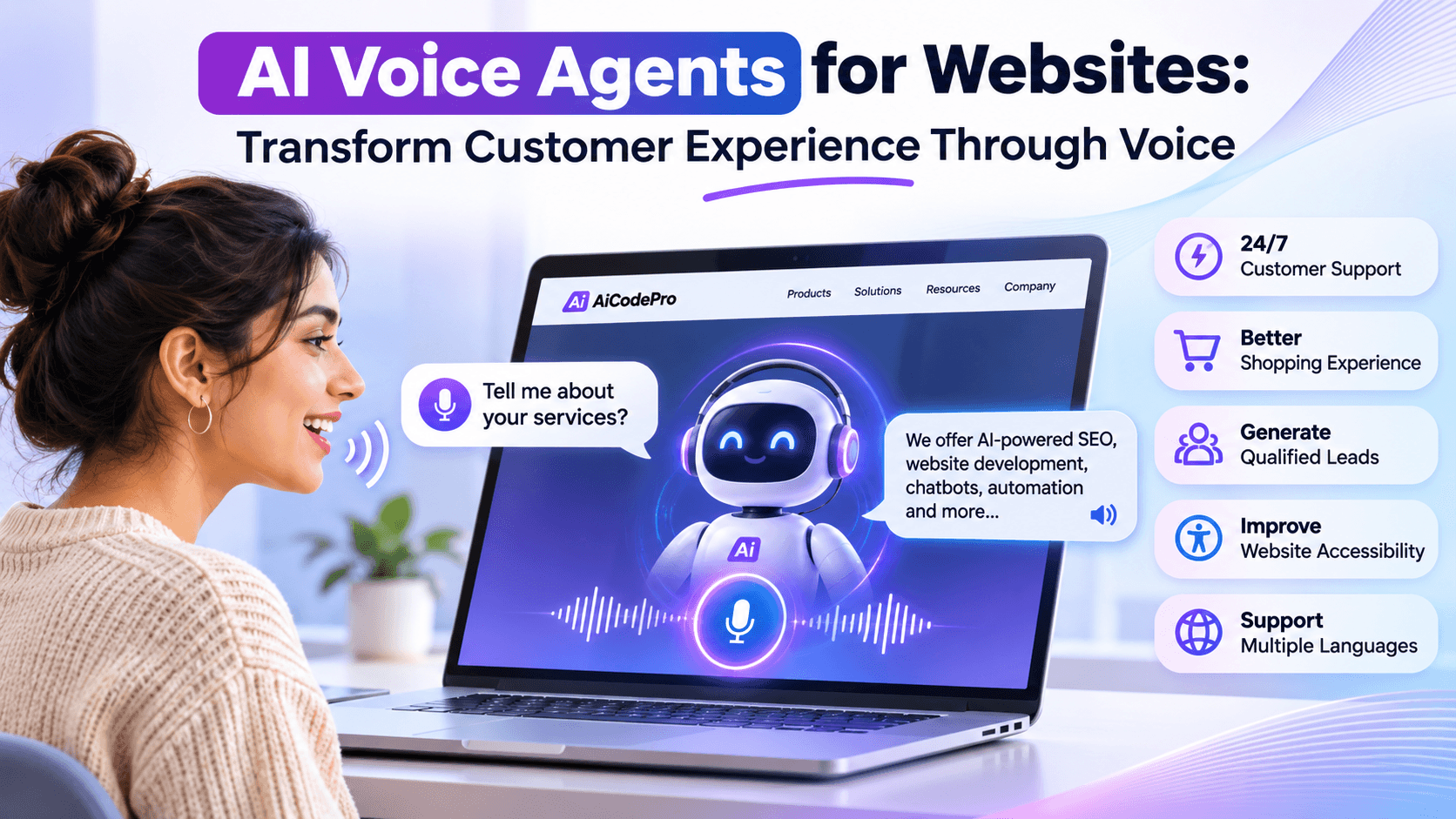
What Is an AI Voice Agent for a Website?
An AI Voice Agent is an intelligent conversational system that allows website visitors to communicate with a website using their voice.
Unlike traditional chatbots that primarily depend on text-based interactions, voice agents allow users to speak naturally and receive spoken responses.
For example, a visitor opens an e-commerce website and asks:
"What are your best-selling products?"
"Do you offer international shipping?"
"Which product would be suitable for a wedding?"
"What is the return policy?"
The AI Voice Agent understands the questions and responds using information available from the website's knowledge base.
A website-integrated AI Voice Agent can work with information such as:
Products and product descriptions.
Services and business information.
Pricing and plans.
Frequently asked questions.
Shipping and return policies.
Documentation and support information.
Company information and website content.
The objective is simple: make website information accessible through natural voice conversations.
How Does an AI Voice Agent Work?
An AI Voice Agent combines speech recognition, artificial intelligence, website knowledge and voice generation to create a conversational experience.
Here is how the process generally works:
1. Voice Input
The visitor clicks the microphone or Tap to Talk button on the website and starts speaking.
For example: "Tell me about your website development services."
2. Speech Recognition
The voice input is converted into text using speech recognition technology. This allows the AI system to understand what the visitor is asking.
3. AI Understanding and Knowledge Retrieval
The AI processes the question and identifies relevant information from its available knowledge base, which can include website pages, product information, FAQs and business documentation.
4. Intelligent Response Generation
The AI generates an answer based on the available information and the context of the conversation.
5. Voice Response
The generated response is converted into natural-sounding speech and played to the visitor.
The visitor can then ask another question without starting a completely new conversation.
This creates a continuous interaction between the visitor and the website.
10 Ways AI Voice Agents Can Help Any Website
The benefits of voice communication are not limited to one industry. Almost any website that provides information, products, services or customer support can benefit from conversational AI.
1. Make Website Information Instantly Accessible
Visitors often leave websites because they cannot find the information they need.
They may have to navigate multiple pages, read lengthy descriptions or search through FAQs to get a simple answer.
An AI Voice Agent simplifies this process.
Visitors can directly ask questions such as:
What services does your company provide?
Where is your office located?
How can I contact your team?
What makes your business different?
The AI agent can provide relevant answers using the website's available information.
This reduces the effort required to find information and creates a more convenient browsing experience.
2. Provide 24/7 Customer Assistance
Customer questions do not always arrive during business hours.
A website may receive visitors late at night, during weekends or from different time zones.
An AI Voice Agent can provide automated assistance whenever the website is accessible, without requiring a human representative to answer every routine question.
It can help visitors understand:
Available services.
Product information.
Frequently asked questions.
Business policies.
General company information.
For businesses serving international customers, this can make website assistance available beyond traditional working hours.
3. Improve E-commerce Shopping Experiences
E-commerce websites contain hundreds or thousands of products. Finding the right product can sometimes become confusing.
An AI Voice Agent can make product discovery more conversational.
For example, a customer visiting an online jewellery store might ask:
"I am looking for bridal jewellery under ₹10,000. What options do you have?"
The agent can use the available product knowledge to explain relevant categories, product features and available options.
It can also answer questions about:
Product materials.
Sizes and variations.
Product availability, when connected to live inventory.
Delivery information.
Return and exchange policies.
This gives customers another way to explore products before making a purchase.
4. Help Generate More Qualified Leads
Many potential customers visit business websites but leave without submitting an enquiry form.
Sometimes they have questions before they are ready to share their contact information.
An AI Voice Agent can help visitors understand the business, its services and the available solutions.
For example, someone visiting a software development company's website might ask:
"Can you build an e-commerce website using Next.js?"
The AI agent can explain the relevant services, answer initial questions and guide the visitor towards the appropriate enquiry or contact page.
When connected to lead capture functionality, it can also collect relevant enquiry details with the visitor's permission.
This can help businesses turn website conversations into potential sales opportunities.
5. Improve Website Accessibility
Not every visitor prefers reading lengthy website content or typing questions.
Some users find voice interaction more convenient, particularly when browsing on mobile devices.
Voice-enabled websites provide an additional interaction method for people who prefer speaking over typing or need an alternative to conventional navigation.
It is important to retain text-based alternatives, keyboard accessibility and accessible controls so visitors can choose the interaction method that works best for them.
6. Create Better Experiences for International Visitors
Businesses increasingly serve customers across different countries.
Language preferences and communication styles can create challenges when visitors interact with a website.
An AI Voice Agent with multilingual capabilities can help visitors communicate in supported languages.
For example:
A customer from India might ask a question in Hindi, while another visitor from the United States may prefer English.
With suitable multilingual speech recognition and voice generation, the AI agent can support both experiences.
This can make business information more accessible to a wider audience.
7. Reduce Repetitive Customer Support Work
Customer support teams frequently answer the same questions.
Examples include:
What are your business hours?
How can I track my order?
What is your refund policy?
How can I book a service?
Where can I find your documentation?
An AI Voice Agent can handle routine informational questions using its website knowledge.
This can reduce repetitive enquiries and allow human support representatives to focus on complex issues that require personal attention.
8. Make Complex Information Easier to Understand
Some websites contain technical information that visitors may find difficult to understand.
This is particularly common on SaaS, technology, financial services, educational and enterprise websites.
Instead of asking visitors to understand technical documentation independently, an AI Voice Agent can explain information conversationally.
For example, a visitor might ask:
"What is the difference between SEO, GEO and AEO?"
The agent can explain the concepts in simpler language and answer follow-up questions.
This makes complex website information easier to explore.
9. Keep Visitors Engaged Through Interactive Conversations
Traditional website browsing is mostly passive. Visitors read information and decide what to click next.
Voice communication introduces an interactive experience.
Visitors can ask follow-up questions, request clarification and explore different topics during the same conversation.
For example:
"What services do you offer?"
"Which service is suitable for a small business?"
"How does the implementation process work?"
"How can I get started?"
The AI Voice Agent can maintain conversational context and respond according to the ongoing discussion.
This can make website interactions feel more natural and engaging.
10. Build a More Intelligent Digital Experience
An AI Voice Agent can become an additional communication layer across a business website.
Rather than functioning only as a support chatbot, it can help visitors discover information, understand services, explore products and navigate available resources.
When integrated with suitable website tools and backend systems, voice agents can also support actions such as:
Searching products.
Checking order information.
Collecting enquiries.
Booking appointments.
Navigating website sections.
Initiating customer support requests.
These actions depend on the integrations, permissions and functionality implemented by the business.
AI Voice Agent vs Traditional Text Chatbot
Both technologies help visitors communicate with a website, but their interaction methods are different.
Feature | Traditional Text Chatbot | AI Voice Agent |
|---|---|---|
Communication | Text-based | Voice-based |
User input | Typing | Speaking |
Response | Written messages | Spoken responses |
Interaction | Text conversation | Natural voice conversation |
Follow-up questions | Supported | Supported |
Website knowledge | Can use website data | Can use website data |
Mobile experience | Typing-based interaction | Hands-free input where supported |
Accessibility | Text interaction | Additional voice interaction |
Multilingual support | Depends on implementation | Depends on speech and language capabilities |
A business does not necessarily need to replace its existing chatbot.
Combining text and voice communication can provide visitors with more flexibility.
Which Industries Can Benefit from AI Voice Agents?
AI Voice Agents can be useful across different types of websites.
E-commerce and Online Shopping
Answer product-related questions.
Explain product specifications.
Help customers discover relevant products.
Provide shipping and return information.
Hotels and Hospitality
Answer questions about hotel facilities.
Explain room categories.
Provide information about amenities.
Guide visitors towards booking pages.
Educational Institutions
Explain courses and programs.
Answer admission-related questions.
Provide fee and eligibility information.
Guide students towards application pages.
Healthcare Websites
Explain available services.
Provide clinic and department information.
Answer general administrative questions.
Guide visitors towards appointment information.
Healthcare voice agents should not replace professional medical advice or emergency assistance.
SaaS and Technology Companies
Explain software features.
Answer technical questions.
Guide users through documentation.
Explain subscription plans.
Help visitors discover suitable solutions.
Real Estate Websites
Explain property features.
Provide information about available projects.
Answer location-related questions.
Guide visitors towards enquiry forms.
Service-Based Businesses
Explain service offerings.
Answer pricing-related questions when information is available.
Collect customer enquiries.
Guide visitors towards consultation requests.
Why Website Knowledge Matters in an AI Voice Agent
One of the most important aspects of an AI Voice Agent is the information it uses to generate responses.
A generic AI assistant may understand general questions, but a business website needs an agent that understands the business itself.
For example, if someone visits a company's website and asks:
"What are your company's main services?"
The agent should provide information about that particular company's services rather than a generic explanation of the industry.
This is where website knowledge integration becomes important.
A website-aware AI Voice Agent can use relevant information from:
Website pages.
Product catalogues.
Service descriptions.
FAQs.
Company documentation.
Business policies.
Other connected knowledge sources.
The quality of responses depends on the accuracy, freshness and coverage of the information available to the AI system.
Businesses should also ensure that sensitive information is protected and that the agent clearly communicates when it does not know an answer.
The Future of Websites Is Conversational
Websites have traditionally been designed around navigation, menus, search bars and forms.
AI is creating opportunities to make these experiences more conversational.
Instead of expecting every visitor to understand a website's structure, businesses can allow visitors to communicate their requirements directly.
Consider the difference:
Traditional website experience:
A visitor opens a website, navigates through different pages, searches for information and eventually finds the answer.
AI-powered voice experience:
A visitor opens a website, speaks a question and receives a relevant spoken response.
This does not mean traditional website navigation will disappear. Instead, voice interaction adds another layer to the overall digital experience.
As speech recognition, AI reasoning and voice generation continue to develop, voice-enabled interactions can become an increasingly useful part of business websites.
How AiCodePro Is Bringing Voice Communication to Websites
At AiCodePro, we believe that websites should do more than display information. They should make it easier for visitors to understand, explore and interact with a business.
Our AI-powered chatbot experience takes website communication beyond conventional text conversations by introducing an AI Voice Agent.
The voice-enabled assistant is designed to understand visitor questions and respond using knowledge of the website.
Visitors can interact through voice rather than relying only on typing.
Whether someone wants to understand a service, explore product information, learn about a company's offerings or find answers to common questions, the AI assistant provides a conversational way to access relevant website information.
What Makes a Website-Aware Voice Agent Useful?
Website-specific knowledge: Responses can be based on the information available on the business website.
Natural voice interaction: Visitors can ask questions by speaking instead of typing.
Contextual conversations: The assistant can handle follow-up questions while maintaining conversation context.
Business-focused assistance: It can explain products, services, policies and other website information.
Flexible integration: Voice interaction can be introduced alongside an existing website chatbot.
Improved visitor experience: Customers get another convenient way to interact with the business.
The goal is to make website communication more natural, accessible and intelligent.
Explore AiCodePro: https://www.aicodepro.com/
Final Thoughts
The way people interact with websites is evolving.
Visitors increasingly expect convenient access to information, quick responses and experiences that understand their requirements.
AI Voice Agents offer businesses a new way to meet these expectations through natural voice communication.
From e-commerce stores and educational institutions to SaaS platforms, hotels and service-based companies, website voice agents can help answer questions, explain information, support product discovery and improve customer interactions.
The real opportunity is not simply adding a microphone button to a website. It is creating an intelligent assistant that understands the business and communicates its knowledge effectively.
The next generation of websites will not just be websites that people browse. They will also be websites that people can talk to.
Discover how AiCodePro can help bring AI-powered conversational experiences to your website: https://www.aicodepro.com/
Share with AI
Summarize this article, answer my questions based on it, and help me understand the key insights with your favorite AI assistant.