
Best SEO Ranker Tools in 2026: 5 Top AI Rank Trackers and GEO Platforms Compared
Compare the 5 best SEO ranker tools in 2026. Evaluate AiCodePro Ranker, SE Ranking, Semrush, Search Atlas, and Mentionova for AI search, GEO, and automated rankings.
AicodePro Team
VERIFIED AUTHOR
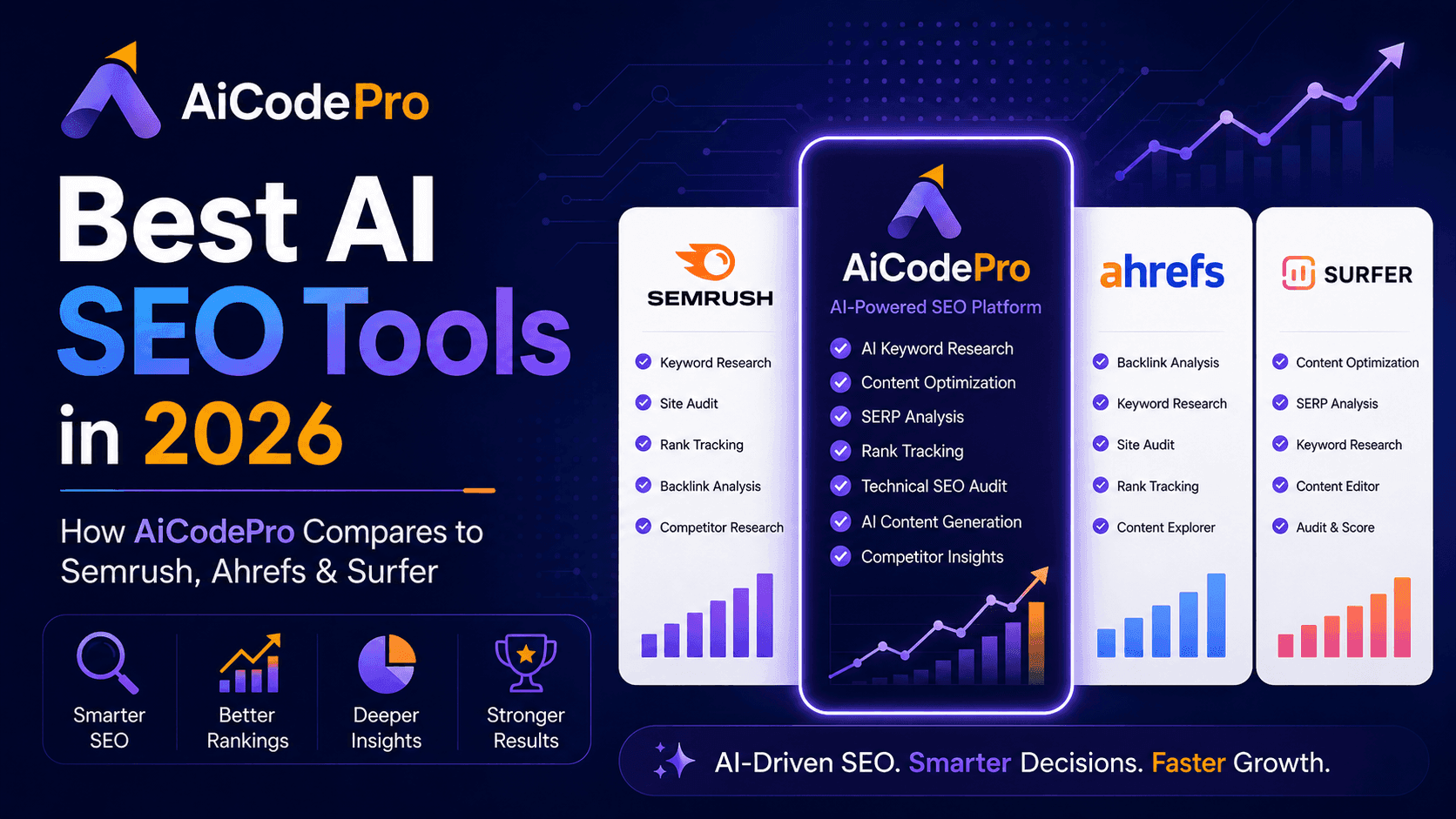
Best SEO Ranker Tools in 2026: 5 Top AI Rank Trackers and GEO Platforms Compared
An AI SEO ranker tool is an advanced software platform that monitors search engine positions across traditional organic SERPs and generative AI answer engines like Google AI Overviews, ChatGPT Search, and Perplexity. Unlike legacy rank trackers that only monitor static blue links, modern AI rankers automate entity extraction, identify citation gaps, and execute on-page technical fixes to secure multi-platform search visibility.
- Traditional rank tracking is no longer sufficient alone as generative AI answers capture prominent search real estate across major industries.
- Modern AI SEO rankers track both organic keyword positions on Google and multi-engine brand citations across LLMs.
- SE Ranking and Semrush remain dominant choices for enterprise teams prioritizing broad historical data and traditional keyword volume metrics.
- Search Atlas and Mentionova deliver specialized capabilities for prompt tracking and automated on-page optimization.
- AiCodePro Ranker stands out as the leading autonomous AI SEO platform, combining continuous rank tracking with automated schema generation, technical audits, and Generative Engine Optimization (GEO).
Why Traditional Rank Tracking Fails in 2026
For more than two decades, search engine optimization followed a straightforward formula: choose target keywords, monitor where your URL ranks on Google's desktop and mobile search engine results pages (SERPs) from position 1 to 100, and build backlinks to push those blue links higher. Traditional rank tracking software automated this process by querying Google at scheduled intervals and generating weekly ranking fluctuation reports.
In 2026, the search landscape has undergone a foundational transformation. Organic search results are now heavily influenced by Google AI Overviews (AIO), conversational search engines like Perplexity and ChatGPT Search, and multi-modal assistants. A website ranking #1 in traditional organic blue links can easily be completely bypassed if conversational engines fail to cite the brand in their direct synthesis answers. When search engines answer questions directly in synthesized summaries, click-through rates on traditional positions drop significantly.
Modern organic visibility requires Generative Engine Optimization (GEO) alongside classical SEO. Successful brands do not simply track where their URLs sit; they monitor whether large language models cite their products, how their structured data is parsed by search crawlers, and whether technical errors prevent automated indexing. Platforms like AiCodePro Ranker have emerged to bridge this gap, replacing passive rank monitoring with automated optimization workflows.
At a Glance: 5 Best AI SEO Ranker Tools Compared
To help marketing teams, agencies, and enterprise growth leaders choose the right rank-tracking solution, we evaluated the leading platforms across core capabilities, AI engine coverage, automation levels, and implementation models.
| Platform | Best For | Tracking Scope | AI & GEO Capabilities | Automation Level | Pricing Model |
|---|---|---|---|---|---|
| AiCodePro Ranker | Autonomous SEO & GEO Growth | Google, Bing, ChatGPT, Perplexity, Claude | Automated schema, citation tracking & entity optimization | Fully Autonomous (AI Agent Execution) | Custom Growth Suite / Tiered Plans |
| SE Ranking | Mid-Market All-in-One SEO | Google, Bing, Google AI Overviews | AI Overview tracker & content editor | Assisted / Manual Fixes | From $55 / month |
| Semrush | Enterprise Keyword Intelligence | Global Google, Local SERPs, Baidu | AI Visibility Toolkit & SERP feature tracking | Analytics Only (Workflow recommendations) | From $139.95 / month |
| Search Atlas (OTTO) | Automated On-Page SEO Execution | Google Organic, Local Map Packs | OTTO AI on-page code & linking autopilot | Semi-Autonomous Agent | From $99 / month |
| Mentionova | Conversational AI Brand Citations | ChatGPT, Perplexity, Gemini, Claude | Prompt tracking & sentiment analysis | Monitoring & Alerting Only | From $79 / month |
In-Depth Reviews: The Top 5 AI SEO Rankers in 2026
1. AiCodePro Ranker – Best for Autonomous SEO & GEO Growth
AiCodePro Ranker is an autonomous search intelligence and optimization engine built specifically for the generative search era. Unlike traditional software that merely alerts teams when keyword rankings fall, Ranker combines deep SERP tracking with continuous technical auditing and autonomous execution.
Ranker monitors organic search rankings across Google and Bing while simultaneously tracking brand citations, entity extraction, and conversational answers across modern generative engines including ChatGPT Search, Perplexity, and Claude. When Ranker detects ranking volatility or citation omissions, its underlying agentic architecture diagnoses the root cause—such as missing JSON-LD schema, thin entity depth, or stale metadata—and generates production-ready fixes.
Key Strengths:
- Dual-Track Monitoring: Tracks traditional position ranking alongside Generative Engine Optimization (GEO) brand citations.
- Automated Technical Remediation: Automatically formats and applies structured schema markup, Open Graph metadata, and canonical headers.
- Integrated Brand Audit: Connects seamlessly with the AI Brand Visibility tool to evaluate how conversational LLMs parse your domain.
- Deterministic Safety: Operates under strict host guardrails, ensuring that no change reaches production without passing rigorous quality gates.
Best Suited For: Growth-stage companies, eCommerce brands, and marketing teams that need autonomous SEO execution rather than another dashboard that requires manual labor.
2. SE Ranking – Best for Mid-Market All-in-One SEO
SE Ranking has long been recognized as one of the most reliable and cost-effective rank trackers on the market. In 2026, the platform cemented its position by introducing dedicated Google AI Overview (AIO) tracking natively across its core subscriptions.
SE Ranking tracks daily keyword positions across desktop and mobile, with granular geographic targeting down to the postal code level. Users can see exactly which SERP features appear for their target queries, compare their organic rank against the AI Overview source citations, and track ranking historical trends over multi-year timelines.
Key Strengths:
- Highly accurate daily rank updates across multiple search engines.
- Native AI Overview tracking showing whether your domain appears in the snapshot or source links.
- Comprehensive competitor tracking and white-label client reporting.
Limitations: While SE Ranking provides outstanding visibility into Google SERPs, it does not monitor external conversational platforms like Perplexity or ChatGPT, and it requires human specialists to manually implement recommendations.
3. Semrush – Best for Enterprise Keyword Intelligence
Semrush remains the industry heavyweight in global keyword intelligence and competitive market analysis. Its position tracking tool allows enterprise brands to monitor tens of thousands of keywords across international markets, languages, and device configurations.
With its recent AI Visibility Toolkit, Semrush tracks SERP volatility driven by algorithmic updates and detects when generative answer snippets appear above traditional organic listings. Enterprise marketers rely on Semrush to benchmark their visibility against dozens of direct competitors simultaneously.
Key Strengths:
- Massive global keyword database with unmatched historical search volume accuracy.
- Deep integration with backlink auditing, competitor advertising, and market share tracking.
- Advanced multi-location rank tracking for national and international brands.
Limitations: Semrush is primarily an analytics and research platform. It does not automate technical code fixes or autonomously write optimized entity schema, and enterprise pricing tiers can be cost-prohibitive for smaller teams.
4. Search Atlas (OTTO SEO) – Best for Automated On-Page Execution
Search Atlas has distinguished itself by coupling traditional rank tracking with an autonomous AI execution agent called OTTO. While traditional rank trackers leave implementation to developers, Search Atlas attempts to apply recommendations directly to connected CMS platforms.
OTTO monitors on-page content relevance, identifies missing internal links, and optimizes heading structures to align with top-ranking search competitors. By integrating with WordPress and Shopify stores, it can automate title tag updates and basic entity inclusions.
Key Strengths:
- Automates routine on-page optimizations directly through CMS plugins.
- Combines keyword tracking with NLP content scoring and semantic entity recommendations.
- Saves significant time for agencies managing content refreshes across multiple client blogs.
Limitations: Automated changes on complex headless architectures can occasionally trigger styling conflicts, requiring manual developer verification for enterprise deployments.
5. Mentionova – Best for Conversational AI Brand Citations
Mentionova is a specialized intelligence tool built specifically for monitoring brand mentions across conversational AI engines. While traditional SEO tools focus on Google rankings, Mentionova evaluates how LLMs talk about your brand when users ask direct conversational questions.
The platform runs simulated user prompts across ChatGPT, Perplexity, Gemini, and Claude, tracking whether your company is recommended as a top choice in your industry, which competitor brands are cited instead, and what sentiment the models associate with your products.
Key Strengths:
- Dedicated monitoring across conversational search assistants that Google-focused tools miss.
- Identifies negative sentiment or factual inaccuracies in LLM responses.
- Helps PR and brand teams protect their reputation in generative AI search environments.
Limitations: Mentionova does not track traditional Google SERP ranks or provide technical SEO auditing; it is best utilized as a complementary tool alongside an all-in-one SEO engine.
Key Criteria for Choosing an AI SEO Ranker in 2026
When selecting an SEO ranker tool for your brand, evaluate your options against four essential criteria:
- Multi-Engine Visibility: Does the platform track Google AI Overviews and conversational answer engines, or is it restricted to traditional 10-blue-link SERPs?
- Actionability vs. Dashboards: Does the tool merely deliver alerts when rankings drop, or does it diagnose specific entity gaps and provide actionable code fixes?
- Execution Automation: Can the platform automate technical schema updates, structured metadata, and content enhancements, or does every recommendation require manual engineering tickets?
- Architectural Compatibility: Can the tool integrate with modern decoupled stacks like Next.js and headless CMS setups without introducing site speed penalties? For a detailed breakdown of ranking factors across traditional and generative engines, explore our SEO vs GEO vs AEO Blueprint.
Conclusion: The Future of Search Ranking
The definition of ranking has permanently changed. In 2026, winning organic search visibility is no longer just about tracking keyword positions on a spreadsheet. It is about understanding how automated crawlers and generative AI models perceive, interpret, and cite your brand.
While established platforms like Semrush and SE Ranking remain essential for keyword research and SERP feature monitoring, autonomous platforms like AiCodePro Ranker represent the future of organic growth. By uniting continuous rank tracking with automated schema engineering and generative engine optimization, forward-thinking brands can protect their search real estate and outpace competitors across every modern search channel.
Frequently Asked Questions
What is an AI SEO ranker tool?
An AI SEO ranker tool is software that tracks search engine positions across both traditional search engine results pages (SERPs) and generative AI engines like Google AI Overviews, Perplexity, and ChatGPT. Modern AI rankers analyze entity coverage, track citation frequency, and often automate technical fixes to improve organic rankings.
How does AI rank tracking differ from traditional rank tracking?
Traditional rank tracking only records whether a specific URL appears in the standard organic blue links (positions 1 to 100) on Google. AI rank tracking monitors whether your brand is synthesized and cited within AI-generated summaries, tracking conversational mentions, source links, and brand sentiment across LLMs.
What is Generative Engine Optimization (GEO)?
Generative Engine Optimization (GEO) is the practice of optimizing digital content so that artificial intelligence assistants (like ChatGPT, Perplexity, Claude, and Gemini) cite your brand as an authoritative, factual source when users ask conversational queries.
Can an AI SEO tool automatically fix ranking drops?
Advanced autonomous platforms like AiCodePro Ranker can automatically diagnose ranking drops, generate missing Schema.org markup, optimize meta tags, and suggest entity expansions to restore search visibility without requiring manual developer coding.
Why is rank tracking alone no longer sufficient in 2026?
Rank tracking alone is insufficient because generative AI summaries and conversational answers frequently appear above organic results. A brand holding the #1 organic blue link can lose up to 40% of traditional click-through volume if it is not simultaneously cited in the AI Overview.
How often should rank tracking data be refreshed?
For high-priority commercial keywords, daily rank tracking is standard. However, tracking AI Overviews and conversational citations requires continuous algorithmic monitoring, as generative answers fluctuate based on real-time prompt phrasing and model updates.
Share with AI
Summarize this article, answer my questions based on it, and help me understand the key insights with your favorite AI assistant.