
Top 10 SEO & Search Visibility Skills for AI Agents in 2026
Discover the 10 best SEO and search visibility skills for Claude Code and AI agents. Automate technical audits, schema validation, LLMs.txt, and rank tracking.
AicodePro Team
VERIFIED AUTHOR
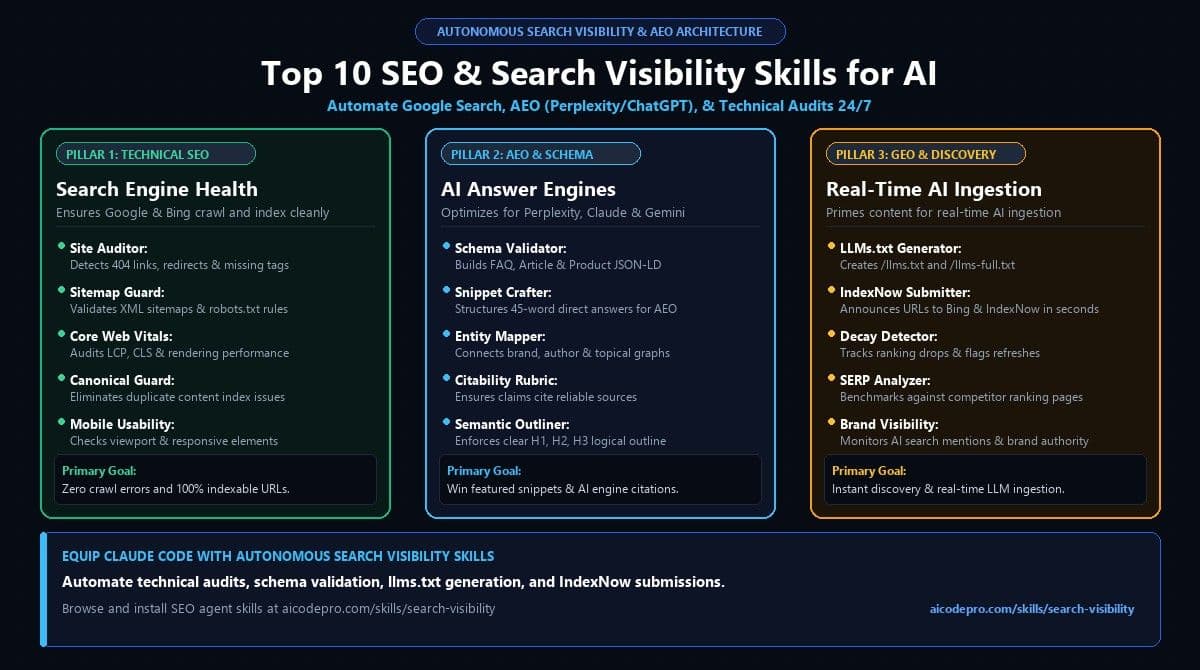
Modern engineering teams use seo skills for claude code to automate technical crawl audits, schema generation, Core Web Vitals checks, and LLMs.txt optimization directly within codebases. By shifting SEO governance from isolated SaaS dashboards directly into terminal developer workflows, autonomous AI agents resolve regressions, validate indexability, and guarantee search visibility before production merges.
- Automated CI/CD SEO Audits: AI agent skills run headless crawler evaluations against ephemeral staging environments and pre-render builds, preventing technical search regressions prior to deployment.
- Answer Engine Optimization (AEO): Purpose-built agentic skills optimize markdown architecture, semantic citations, and entity density for retrieval engines like Perplexity, ChatGPT Search, and Gemini.
- Zero-Token Overhead: By operating via deterministic CLI subroutines and targeted headless scrapers, specialized skills minimize context payload costs during typical development loops.
- Automated IndexNow & Search Submission: Changes commit directly into automated API submission pipelines, pushing new and updated URLs immediately to Bing and Yandex indexers.
- Instant Workspace Installation: Verified agent skills can be cloned or submoduled into local workspaces via standard terminal commands from community catalogs.
Why Agentic SEO Replaces Manual Auditing Tools
For more than two decades, search engine optimization operated as an observational, decoupled discipline. Engineering teams developed web applications in IDEs and git repositories, while digital marketing specialists ran external audits using standalone SaaS platforms such as Semrush, Ahrefs, and Screaming Frog. This traditional architecture introduced structural friction: an external crawler discovered broken canonical tags, 404 links, unminified hydration payloads, or invalid OpenGraph tags weeks after a release, compiled those findings into static CSV spreadsheets or Jira tickets, and tossed them back over the wall to engineers who lacked context.
In 2026, autonomous agent runtimes like Claude Code transform SEO from a retrospective reporting exercise into active, in-repo execution. When equipped with specialized search visibility capabilities, the agent does not merely highlight an unoptimized title tag or a missing Schema.org breadcrumb. Instead, the terminal-bound agent scans local codebases, queries AST parsers, inspects routing tables in Next.js, Nuxt, Astro, or SvelteKit, and executes headful or headless browser passes on local dev servers.
Once a discrepancy surfaces, such as an invalid rel="canonical" URL structure or a missing ImageObject property, the agent creates an isolated branch, refactors the underlying TSX or template component, tests the generated static markup against schema specifications, and opens a pull request. The loop from discovery to remediation collapses from a two-week sprint delay down to an automated 30-second terminal command.
The 10 Best SEO Skills for Claude Code & Autonomous Agents
To establish autonomous search visibility workflows, developers can deploy specialized capabilities from the Search Visibility Skills library and the broader AiCodePro Skills Directory. Below are the ten top-tier skills driving search visibility for AI-assisted engineering teams in 2026.
1. Autonomous Site & Technical Health Auditor
Core Capabilities: Executes programmatic crawl passes across local development environments, previews, or live staging ports (e.g., http://localhost:3000). Evaluates HTTP status responses, redirect chains (301, 302, 308), meta tag completeness, viewport setups, and trailing slash parity.
Execution Triggers: Runs automatically on pre-commit hooks, pull request reviews, or on-demand via the terminal command /audit-technical-health.
Workflow Impact: Prevents 4xx errors, broken internal routing, and missing indexation meta directives from reaching production environments.
2. Schema.org JSON-LD Generator & Validator
Core Capabilities: Scans structured data modules across content schemas, generating compliant application/ld+json blocks for Articles, SoftwareApplications, FAQs, HowTos, Organizations, and Products. Validates generated scripts against official specifications and Google Rich Results guidelines.
Execution Triggers: Triggers whenever schema files, CMS templates, or dynamic programmatic routes are modified.
Workflow Impact: Guarantees 100% Google Rich Results compliance without requiring engineers to manually reference changing Schema.org vocabulary definitions.
3. LLMs.txt & AI Crawler Optimization Skill
Core Capabilities: Curates, builds, and maintains standardized /llms.txt and /llms-full.txt root manifest files. Strips interactive client-side clutter, formats core documentation into concise Markdown hierarchy, and configures distinct permissions for AI crawler user-agents (e.g., GPTBot, ClaudeBot, PerplexityBot).
Execution Triggers: Executes post-build or upon updates to product docs and core marketing copy.
Workflow Impact: Positions web assets for prioritized retrieval and high-fidelity parsing by generative engine answer layers.
4. Core Web Vitals & Hydration Inspector
Core Capabilities: Runs headless Chrome instances using Lighthouse and custom PerformanceObserver scripts to evaluate Largest Contentful Paint (LCP), Interaction to Next Paint (INP), and Cumulative Layout Shift (CLS). Flags heavy third-party tags, hydration delays, and unoptimized layout elements.
Execution Triggers: Initiated during pull request performance regressions checks or local UI refactors.
Workflow Impact: Keeps the codebase firmly inside Google's "Good" Core Web Vitals thresholds, safeguarding page experience ranking signals.
5. Semantic Keyword Clustering & Cannibalization Detector
Core Capabilities: Analyzes raw Markdown files, MDX content directories, and headless CMS payloads to map keyword entity distributions. Identifies internal keyword cannibalization where multiple pages compete for identical query vectors and entity themes.
Execution Triggers: Runs prior to creating new content pages or during site-wide editorial audits.
Workflow Impact: Prevents self-inflicted ranking dilution by highlighting cross-linking requirements or suggesting target query consolidations.
6. Internal Link Equity & Hub-and-Spoke Architect
Core Capabilities: Parses the internal link graph across your routing architecture. Detects orphan pages, excessive click depths, and missing contextual cross-links, automatically injecting contextual anchor text linking child pages back to parent pillar hubs.
Execution Triggers: Run on scheduled site maintenance tasks or after large documentation additions.
Workflow Impact: Efficiently redistributes PageRank equity across critical landing pages and documentation hubs.
7. Answer Engine Optimization (AEO) & Citability Scorer
Core Capabilities: Evaluates informational copy against answer engine extraction patterns. Analyzes whether definitions, numerical statistics, step-by-step procedures, and direct entity answers are framed concisely within clean semantic tags for straightforward citation extraction.
Execution Triggers: Invoked when drafting or updating knowledge-base entries, landing pages, and educational tutorials.
Workflow Impact: Significantly increases citation frequency across Perplexity, ChatGPT Search, Microsoft Copilot, and Google AI Overviews.
8. Robots.txt, Sitemap.xml & Hreflang Boundary Guard
Core Capabilities: Dynamically compiles and verifies robots.txt crawl policies, sitemap.xml indexes, and regional hreflang alternates. Verifies that no critical routes are accidentally noindexed or blocked via wildcard disallow directives.
Execution Triggers: Pre-release CI/CD gates and branch merges into primary production trunks.
Workflow Impact: Eliminates catastrophic site-wide de-indexing caused by mismatched staging configurations leaking into production.
9. Instant IndexNow & Bing Search Submission Skill
Core Capabilities: Hooks directly into project build chains and content publishing events to communicate with the IndexNow protocol and search submission APIs. Packages mutated, newly minted, or purged URLs and dispatches instant verification keys to participating search engines.
Execution Triggers: Triggered during automated deployment webhooks or CMS publish notifications.
Workflow Impact: Accelerates crawl discovery from several days down to seconds without waiting for standard discovery cycles.
10. Competitor Content Gap & SERP Intent Analyzer
Core Capabilities: Leverages search APIs and headless fetch routines to pull top-ranking SERP structures for target queries. Extracts heading distributions (H2, H3), schema types, and intent classifications, drafting prescriptive layout recommendations directly within the developer's scratchpad.
Execution Triggers: Triggered during content ideation and new feature page design workflows.
Workflow Impact: Provides programmatic competitive intelligence before code is written, ensuring landing page structures match current search intent.
Feature & Impact Comparison Table
| Skill Name | Primary Audit Focus | Frequency | Automated Output | Implementation Effort |
|---|---|---|---|---|
| Autonomous Site Health Auditor | HTTP codes, redirects, metadata, broken assets | CI/CD & Pre-commit | Fix PR with corrected routes | Low (CLI plugin) |
| Schema.org JSON-LD Generator | Structured data, entity schemas, Rich Results | On Content Change | Validated JSON-LD code blocks | Low (Plug & play) |
| LLMs.txt & Crawler Optimizer | LLMs.txt manifests, AI bot accessibility | Post-build / Weekly | Updated /llms.txt and /llms-full.txt | Minimal |
| Core Web Vitals Inspector | LCP, INP, CLS, hydration performance | Per PR review | Lighthouse score report & patch | Medium |
| Semantic Clustering & Cannibalization | Entity overlap, keyword dilution | Monthly / Quarterly | Markdown consolidation plan | Medium |
| Internal Link Equity Architect | Orphan pages, click depth, link equity | Bi-weekly | Contextual internal anchor edits | Low |
| AEO & Citability Scorer | Answer engine citation patterns, semantic structure | During content authoring | Structural copy revisions | Low |
| Robots.txt & Sitemap Guard | Crawl directives, XML validity, hreflang | Deployment pipeline | Generated sitemaps & crawl rules | Minimal |
| Instant IndexNow Submitter | Real-time crawl signals to Bing & Yandex | Continuous (on-deploy) | API submission logs | Minimal |
| Competitor SERP Intent Analyzer | SERP headings, content gaps, intent parity | Ad-hoc / Planning | Scaffolded content templates | Medium |
How to Install and Run Search Visibility Skills
Integrating SEO automation into your local Claude Code terminal runtime is straightforward. Skills can be loaded directly as modular submodules, installed via local config packages, or referenced using custom skill pointers. For comprehensive instructions and advanced configurations, review the official Skills How-To Guide.
Method 1: Git Submodule Integration (Recommended for Teams)
To persist verified skills across your engineering team directly within your project's version control, add the search visibility skill repository as a submodule into your agent skills directory:
# Navigate to your project repository root
cd /path/to/your/project

# Add the search visibility skill package into your skills configuration folder
git submodule add https://github.com/aicodepro/skill-search-visibility.git .gemini/skills/search-visibility

# Verify that Claude Code discovers the skill definition
claude skills list
Method 2: Standalone Archive or Direct Directory Injection
If you prefer running standalone skills without git submodule bindings:
# Create your local skills folder if it doesn't exist
mkdir -p .gemini/skills/search-visibility

# Download and unpack the skill package
curl -fsSL https://aicodepro.com/downloads/skills/search-visibility.tar.gz | tar -xz -C .gemini/skills/search-visibility

# Run a technical SEO audit using your active Claude Code session
claude "Run technical SEO health check on http://localhost:3000"
Once registered, skills activate natively based on context. For example, typing /generate-schema or prompting "Validate all metadata and canonical links across our blog routes before deploying" causes Claude Code to execute the necessary subroutines, inspect the generated DOM, and report findings right in your terminal console.
Can Claude Code run SEO audits on local localhost environments before deploying?
Yes. By pairing Claude Code with local headless browsing adapters (such as Puppeteer or Playwright), the agent launches your local development server, renders pages dynamically, evaluates raw and client-hydrated DOM structures, checks HTTP response codes, and verifies metadata before any commit touches your remote repository.
How do AI agent skills handle Google Search Console and GA4 data?
Agent skills interface with Google Search Console and GA4 APIs using localized OAuth keys or environment tokens. This enables Claude Code to query real-world impression trends, identify high-volume pages experiencing click drop-offs, and suggest targeted code or content modifications directly to resolve search declines.
Does running SEO skills require expensive third-party SEO subscriptions?
No. While skills can optionally integrate with third-party SEO tool APIs for external backlink data, core technical checks, such as Schema.org generation, Core Web Vitals profiling, crawl budget analysis, internal link graph mapping, and IndexNow pings, run entirely locally and independently without paid SaaS subscriptions.
What is Answer Engine Optimization (AEO) and why do agents need it in 2026?
Answer Engine Optimization focuses on structuring digital assets so AI synthesis engines (like Perplexity, ChatGPT Search, and Google Gemini) easily parse, extract, and cite your content in generative answers. Agent skills automate this by ensuring semantic HTML clarity, verifiable statistics, structured definitions, and clean machine-readable summaries exist across all target pages.
Where can I download pre-configured SEO skills for Claude Code?
Pre-configured, battle-tested search visibility and developer skills are maintained in the AiCodePro Search Visibility Skills Hub as well as the central AiCodePro AI Skills Directory.
Sources
Share with AI
Summarize this article, answer my questions based on it, and help me understand the key insights with your favorite AI assistant.