
AI Automation: How Businesses Can Work Smarter and Grow Faster
Explore how AI automation is transforming modern businesses. Learn how intelligent workflows, AI agents, and automated processes reduce manual work, improve productivity, lower operational costs, and help businesses scale faster.
Oextech Team
VERIFIED AUTHOR
Businesses today are under constant pressure to work faster, reduce operational costs, improve customer experiences, and stay competitive. However, many organizations still depend on repetitive manual tasks, disconnected software systems, and time-consuming business processes.
This is where AI automation is transforming the way businesses operate.
AI automation combines Artificial Intelligence (AI), machine learning, and workflow automation to perform tasks, analyze information, make intelligent decisions, and streamline business operations with minimal human intervention.
From automated customer support and lead management to intelligent data processing and e-commerce operations, AI automation helps businesses save time, improve accuracy, and focus on strategic growth.
Whether you operate a startup, an e-commerce business, or a large enterprise, implementing AI-powered automation can help you build more efficient and scalable operations.
What Is AI Automation?
AI automation is the use of artificial intelligence technologies to automate business processes that traditionally require human effort. Unlike traditional automation, which follows predefined rules, AI automation can analyze data, understand patterns, process natural language, and adapt to different situations.
For example, traditional automation can send an email when someone submits a contact form. AI automation can go further by understanding the customer's message, identifying their requirements, categorizing the inquiry, generating a personalized response, and directing the lead to the appropriate sales team.
AI automation can involve several technologies, including:
Machine Learning: Helps systems identify patterns and improve decisions using data.
Natural Language Processing (NLP): Enables computers to understand and respond to human language.
Generative AI: Creates content, summaries, responses, and other information.
AI Agents: Performs multi-step tasks by understanding goals and using available tools.
Robotic Process Automation (RPA): Automates repetitive, rule-based digital tasks.
Workflow Automation: Connects different applications and systems to execute business processes.
Together, these technologies allow businesses to automate more than individual tasks. They can automate entire workflows.
How Does AI Automation Work?
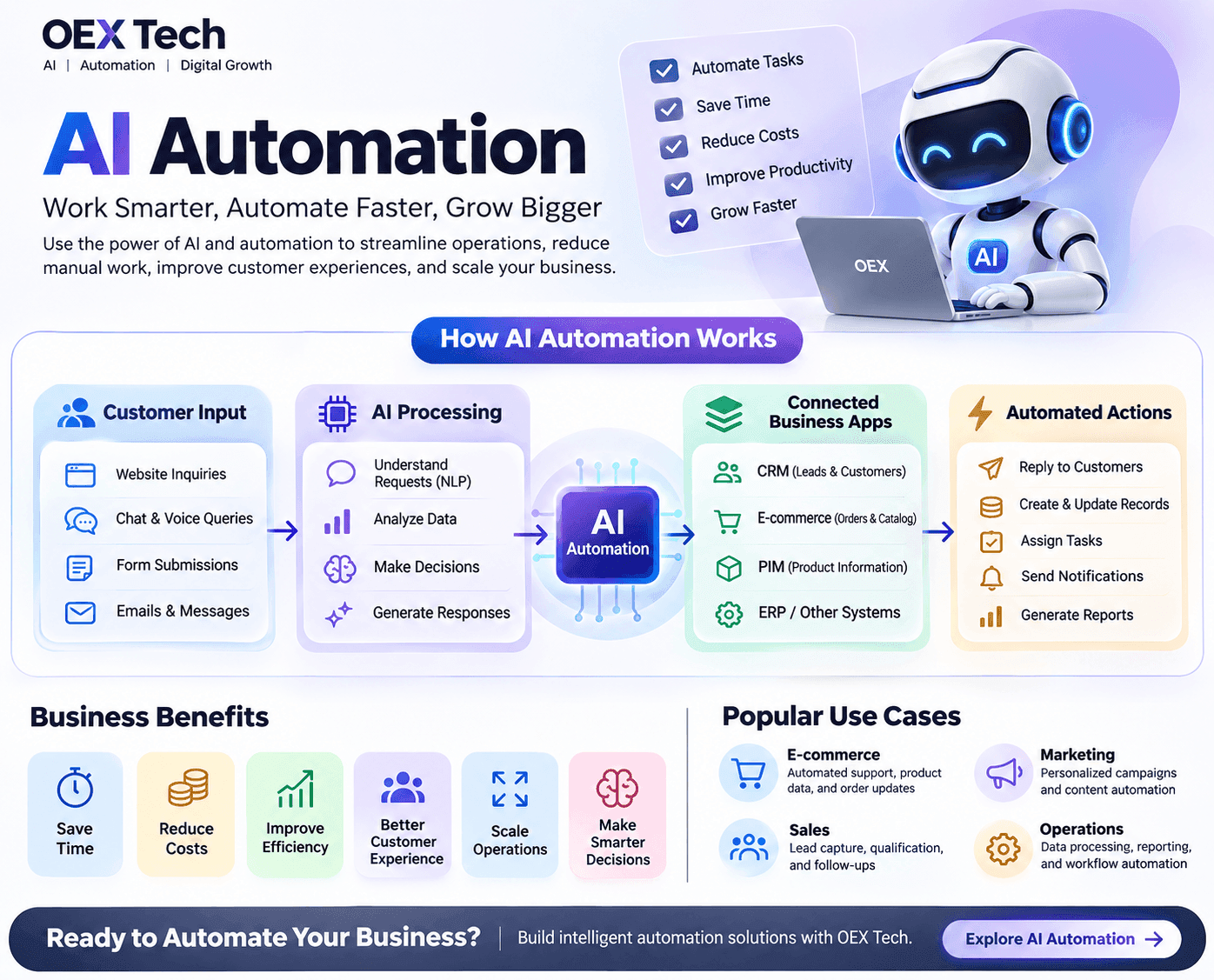
AI automation works by combining business data, intelligent models, connected applications, and predefined workflows.
A typical AI automation process involves five stages:
1. Data Collection
The system collects information from websites, customer forms, CRM platforms, databases, emails, and other business applications.
2. Data Analysis
AI models analyze the collected information, recognize patterns, understand user requirements, and identify relevant details.
3. Decision Making
Based on the available information and business rules, the AI system determines the appropriate next action.
4. Automated Execution
The automation system performs tasks such as sending emails, updating databases, assigning leads, generating reports, or responding to customer inquiries.
5. Monitoring and Optimization
Businesses monitor automation performance, review results, and improve workflows to achieve better efficiency and accuracy.
For example, an AI-powered sales automation system can receive a customer inquiry, understand the customer's requirements, identify the relevant product or service, update the CRM, and notify the sales representative.
This reduces manual work while making business processes more efficient.
Benefits of AI Automation for Businesses
AI automation offers several advantages that can improve business performance and operational efficiency.
1. Reduces Repetitive Manual Work
Employees often spend significant time performing repetitive activities such as data entry, email management, appointment scheduling, report generation, and customer follow-ups.
AI automation can handle many of these activities automatically, allowing employees to focus on more valuable responsibilities.
2. Improves Operational Efficiency
Automated workflows can process tasks consistently and execute multiple operations without requiring manual intervention at every stage.
This helps businesses reduce unnecessary delays and improve coordination between departments.
3. Reduces Operational Costs
Automating repetitive processes can reduce the amount of time employees spend on routine activities. Businesses can use their existing workforce more effectively and minimize avoidable operational expenses.
4. Improves Customer Experience
AI-powered chatbots and voice agents can respond to customer questions, provide product information, guide users through websites, and assist with common support requests.
With properly configured systems, customers can receive assistance beyond traditional business hours.
5. Supports Better Decision-Making
AI systems can analyze large amounts of business data and identify patterns that may be difficult to recognize manually.
Businesses can use these insights to understand customer behavior, evaluate performance, identify opportunities, and make more informed decisions.
6. Enables Business Scalability
As a business grows, its operational workload also increases. AI automation allows organizations to handle more inquiries, transactions, and repetitive processes without increasing manual workload at the same rate.
Top AI Automation Use Cases Across Industries
AI automation is not limited to one industry. Businesses across different sectors can use intelligent automation to improve their operations.
1. E-commerce and Retail
E-commerce businesses manage large amounts of product information, customer inquiries, orders, inventory, and marketing activities.
AI automation can help with:
Automated customer support and product recommendations.
Product description generation and enrichment.
Inventory monitoring and notifications.
Order status communication.
Customer segmentation and personalized marketing.
Product catalog management.
For example, an AI-powered shopping assistant can understand customer requirements through text or voice, recommend relevant products, answer product-related questions, and guide customers through their shopping journey.
2. Sales and Lead Management
Sales teams often spend considerable time identifying leads, updating CRM records, and following up with potential customers.
AI automation can:
Capture leads from website forms.
Categorize leads based on their requirements.
Analyze customer inquiries.
Automatically update CRM systems.
Generate personalized follow-up messages.
Notify sales representatives about high-priority opportunities.
This helps businesses manage leads more efficiently and reduce the possibility of missed opportunities.
3. Customer Support
Customer support teams receive similar questions about products, services, payments, delivery, and account-related issues.
AI automation can handle common inquiries through intelligent chatbots and voice agents.
These systems can provide instant responses, access approved knowledge sources, and transfer complex issues to human support representatives when necessary.
4. Marketing and Content Management
Marketing teams manage campaigns, content production, customer segmentation, and performance reporting.
AI automation can assist with:
Content research and topic identification.
SEO content optimization.
Email campaign personalization.
Social media content scheduling.
Customer behavior analysis.
Automated marketing reports.
Human review remains important to maintain accuracy, originality, and brand consistency.
5. Education
Educational institutions can use AI automation to simplify administrative and communication processes.
Examples include automated admission inquiries, student support, application processing, appointment scheduling, and personalized learning assistance.
6. Manufacturing
Manufacturing companies can use AI-powered automation for production monitoring, predictive maintenance, quality inspection, inventory planning, and supply chain optimization.
These applications can help identify potential problems earlier and improve operational planning.
AI Automation vs Traditional Automation
Traditional automation and AI automation both help businesses reduce manual work, but they operate differently.
Feature | Traditional Automation | AI Automation |
|---|---|---|
Working method | Predefined rules | AI-driven analysis and rules |
Data processing | Structured data | Structured and unstructured data |
Decision-making | Rule-based | Context-aware and data-driven |
Language understanding | Limited | Natural language processing |
Adaptability | Requires manual changes | Can adapt within configured capabilities |
Best suited for | Repetitive fixed tasks | Complex and variable workflows |
Example:
Traditional automation sends the same confirmation email whenever a customer places an order.
AI automation can understand a customer's question about that order, retrieve relevant information from connected systems, and generate a contextual response.
However, AI automation is not always the best choice. Simple, predictable tasks may be more efficiently handled through traditional rule-based automation. Businesses should select the approach based on the process requirements.
What Are AI Agents and How Do They Support AI Automation?
AI agents are intelligent software systems that can understand instructions, plan actions, interact with connected tools, and complete multi-step tasks within defined permissions.
They take AI automation beyond simple question-and-answer interactions.
For example, a website AI agent can:
Understand what a visitor wants.
Search relevant website information.
Recommend products or services.
Check information through connected systems.
Guide visitors through the next steps.
Escalate complex requests when required.
AI agents can be particularly useful for businesses that want to automate customer interactions, internal workflows, and repetitive operational activities.
The key difference is that a basic chatbot primarily responds to questions, whereas a properly configured AI agent can also perform authorized actions using connected tools.
How to Implement AI Automation in Your Business
Successful AI automation starts with identifying the right business processes rather than automating everything immediately.
Here is a practical implementation approach:
Step 1: Identify Repetitive Business Processes
Identify tasks that consume significant employee time, occur frequently, or involve repeated data handling.
Examples include customer inquiries, lead management, reporting, and data entry.
Step 2: Define Automation Goals
Establish measurable objectives such as reducing response time, decreasing manual data entry, improving lead response rates, or shortening processing times.
Step 3: Select the Right AI Technologies
Choose suitable AI models, automation platforms, APIs, and integrations based on your requirements.
Step 4: Integrate Existing Business Systems
Connect AI automation with your existing website, CRM, e-commerce platform, databases, communication tools, and internal applications.
Step 5: Test and Monitor
Test automated workflows using real-world scenarios. Review accuracy, security, performance, and exception handling before expanding their use.
Step 6: Scale Gradually
Start with a few high-impact workflows, measure their results, and expand automation across other departments as your requirements evolve.
Challenges and Considerations in AI Automation
Although AI automation offers significant opportunities, businesses should consider certain challenges before implementation.
Data privacy and security: Customer and business information must be handled securely, with appropriate access controls and data protection measures.
Integration complexity: Connecting AI systems with existing software may require custom APIs and backend development.
Accuracy and reliability: AI-generated outputs can sometimes contain incorrect information. Important decisions and customer-facing processes should have appropriate validation mechanisms.
Implementation costs: Businesses should evaluate development, integration, infrastructure, and maintenance costs before selecting a solution.
Human supervision: Sensitive decisions and complex workflows may require human approval, monitoring, or intervention.
A well-designed AI automation strategy balances intelligent systems with human oversight.
How OEX Tech Helps Businesses Implement AI Automation
At OEX Tech, we help businesses explore and implement intelligent technology solutions that improve operational efficiency and support digital growth.
Our approach focuses on building automation systems around actual business requirements rather than introducing technology without a clear purpose.
Our AI and technology capabilities include:
AI Agent Development
Build intelligent AI agents that understand customer requirements, access relevant information, interact with connected tools, and support business workflows.
AI Chatbot and Voice Agent Development
Improve customer communication through AI-powered chatbots and voice agents that provide natural, conversational assistance.
Business Workflow Automation
Automate repetitive operations, connect business applications, streamline data processing, and reduce manual intervention.
E-commerce Automation
Improve e-commerce operations through intelligent product information management, automated customer interactions, and connected commerce workflows.
AI Integration Services
Integrate AI capabilities into existing websites, applications, CRM systems, and business platforms.
Whether you are a startup looking to automate your first workflow or an established organization planning a larger AI transformation, OEX Tech can help you identify suitable automation opportunities and develop solutions aligned with your business goals.
Explore our services at https://oextech.in/.
The Future of AI Automation
AI automation is evolving from simple task execution toward intelligent systems that can understand context, coordinate workflows, and interact with multiple business applications.
The growing adoption of AI agents, generative AI, voice interfaces, and connected enterprise systems is creating new opportunities for organizations.
In the coming years, businesses will increasingly use AI-powered systems to manage customer interactions, streamline internal operations, process information, and support decision-making.
However, successful adoption will depend on more than choosing the latest AI technology. Businesses will need reliable data, secure integrations, clearly defined workflows, and appropriate human supervision.
Organizations that approach AI automation strategically can build more efficient, responsive, and scalable business operations.
Conclusion
AI automation is changing how businesses manage daily operations, communicate with customers, and scale their services.
By combining artificial intelligence with workflow automation, organizations can reduce repetitive work, improve productivity, streamline processes, and make better use of their resources.
From AI chatbots and voice agents to intelligent workflow systems and e-commerce automation, the opportunities are expanding across industries.
The best time to explore AI automation is when you can identify a real business challenge that intelligent technology can solve.
Ready to make your business smarter with AI automation? Connect with OEX Tech to explore intelligent automation solutions for your business.
Share with AI
Summarize this article, answer my questions based on it, and help me understand the key insights with your favorite AI assistant.