
How AI Mode and Agentic Browsing Benefit Modern Businesses
Your customers aren't just searching anymore — AI is browsing, comparing, and deciding for them. Here's what AI Mode and agentic browsing actually mean for your business, and how to make sure AI systems find (and trust) you.
Aicodepro Team
VERIFIED AUTHOR
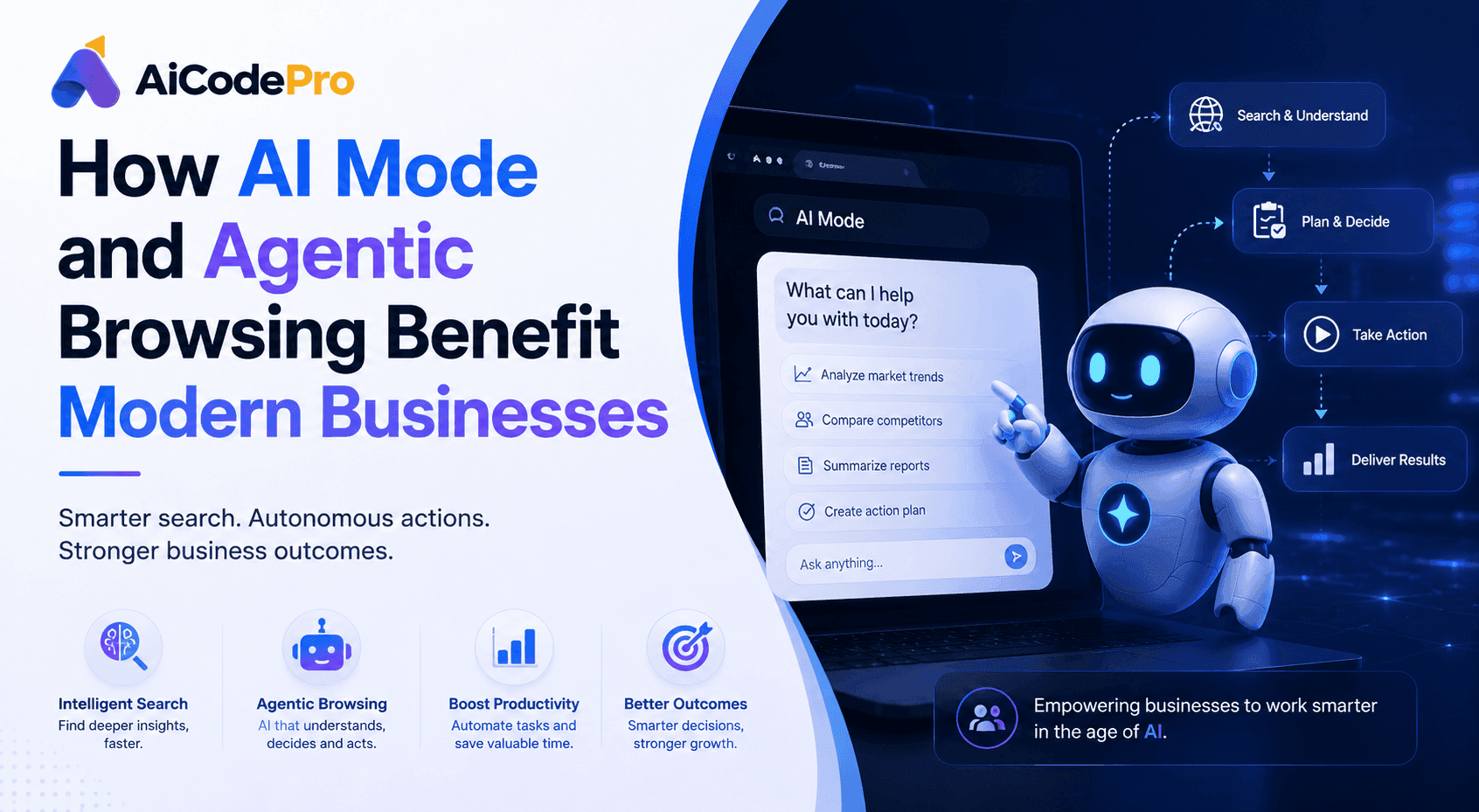
AI Mode and agentic browsing are changing how people find and act on information online. AI Mode interprets complex questions and returns organised, conversational answers instead of a list of links. Agentic browsing goes a step further, allowing an AI system to independently navigate websites, compare information across sources and complete multi-step digital tasks on a user's behalf, within set permissions.
Key Takeaways
AI Mode provides contextual, conversational answers instead of a simple list of search results.
Agentic browsing can carry out multi-step online actions, such as comparing options across several sites.
Businesses can use both technologies to improve productivity and reduce manual research time.
Websites that are technically clear and well-structured are easier for AI platforms to interpret accurately.
Human oversight, reliable data and clear privacy controls remain essential as automation increases.
Visibility in AI-driven search increasingly depends on structured, trustworthy content, not keywords alone.
What Are AI Mode and Agentic Browsing?
AI Mode is a search experience that interprets a user's intent, even when the question is layered or conversational, and responds with an organised, contextual answer rather than a page of blue links. It draws on multiple sources at once and can handle follow-up questions within the same conversation, similar to how a knowledgeable colleague might respond to a query.
Agentic browsing extends this idea into action. Instead of only answering questions, an AI agent can open relevant pages, gather details, compare options against criteria a user sets, and carry out approved steps toward a defined goal. It still depends on permissions and boundaries set by the user or business, particularly for anything involving payments, personal data or account changes.
A short example: A marketing manager researching event-management software might use AI Mode to ask which platforms suit small teams and get a summarised comparison of features and pricing tiers. With agentic browsing, they could then ask an AI agent to visit shortlisted vendor sites, pull current pricing and support details into one document, and flag which options meet a specific budget, saving the manual work of visiting each site individually.
AI Mode vs Traditional Search
Understanding AI Mode vs traditional search helps businesses see why user behaviour, and the way information needs to be structured, is shifting.
Factor | Traditional Search | AI Mode |
|---|---|---|
User interaction | Type keywords, scan a results page | Ask natural, conversational questions |
Type of result | List of ranked links | Synthesised, contextual answer |
Query complexity | Best suited to short, specific queries | Handles layered, multi-part questions |
Personalisation | Limited, mostly based on location and history | Can factor in context from the ongoing conversation |
Follow-up questions | Usually requires a new search | Supported within the same session |
Research effort | User reviews multiple pages manually | AI Mode consolidates information upfront |
Business visibility requirements | Keyword ranking on a results page | Clear, structured, quotable content that AI systems can interpret |
Traditional search still has a place, particularly for navigational and transactional queries, but businesses need to account for both approaches in how they present information online.
How Agentic Browsing Differs from Traditional Browsing
Traditional browsing places the entire workload on the user: opening tabs, reading pages, comparing details and manually assembling a conclusion. Every step, from search to synthesis, depends on human time and attention.
Agentic browsing can interpret a stated objective, break it into steps, visit relevant sources and return an organised result. This does not mean it operates without limits. Reputable implementations still require user permissions for sensitive actions, and businesses should treat agentic browsing as an assistant that speeds up defined tasks rather than a fully autonomous decision-maker.
Key Benefits of AI Mode and Agentic Browsing for Businesses
Faster and More Efficient Research
Research that once involved opening a dozen browser tabs can be condensed significantly. Instead of manually collecting and summarising information, teams can direct an AI system toward a specific goal and review a consolidated output.
Common use cases include competitor research, market analysis, vendor evaluation and gathering source material for content projects. This does not remove the need for verification, but it reduces the repetitive groundwork before analysis can begin.
Intelligent Business Automation
AI-powered business automation can support repetitive digital workflows such as collecting product information, monitoring publicly available pricing, or coordinating simple multi-step research tasks. This works best when applied to clearly defined, rules-based processes.
It is worth being clear that this is support for existing teams, not a replacement for them. Strategic judgement, client relationships and nuanced decisions still require people.
Better and Faster Decision-Making
When information arrives already organised and compared, teams can move to evaluation more quickly instead of spending time assembling raw data. Contextual summaries can highlight relevant differences between options, such as vendor features or market trends.
Even so, important financial, legal or strategic decisions should always involve human review before being finalised. AI-generated summaries are a starting point for analysis, not a substitute for it.
Improved Customer Experiences
AI-powered browsing and conversational search can help customers find relevant products, services or answers with fewer steps. A shopper describing a general need in natural language, for instance, may receive a more relevant set of suggestions than they would from a standard keyword search.
Personalisation in this context depends on the platform and the data available, and businesses should avoid assuming a fixed or guaranteed level of tailoring, since capabilities continue to evolve across different AI search providers.
Greater Productivity Across Teams
The benefits extend across departments. Marketing teams can speed up topic and competitor research. Sales teams can gather background on prospects more efficiently. Customer service teams can access consolidated information faster, while operations and e-commerce teams can use agentic tools to monitor listings, pricing pages or supplier information.
Stronger Visibility in AI Search
For a business to appear reliably in AI search for businesses, its website needs to be technically accessible, logically structured and backed by credible, genuinely useful content. Agentic AI for business tools are more likely to reference sites that are easy to parse and clearly written.
This is where AI-powered browsing intersects with content strategy: an AI agent evaluating a website behaves less like a human skimming a page and more like a system extracting facts, so clarity and structure matter as much as the information itself.
Practical Business Use Cases
Business Function | AI Mode or Agentic Browsing Use Case | Potential Benefit |
|---|---|---|
Market research | Ask AI Mode to summarise trends across an industry | Faster orientation before deeper research |
Competitor analysis | Agentic browsing compares competitor websites and offerings | Consolidated comparison without manual tab-switching |
Lead research | AI Mode gathers publicly available background on a prospect company | Better-prepared outreach and sales conversations |
Customer support | Conversational search helps customers self-serve answers | Reduced repetitive support queries |
Product discovery | AI Mode interprets a customer's natural-language need | More relevant product suggestions |
Vendor comparison | Agentic browsing collects pricing and feature details across vendor sites | Time saved during procurement research |
Content planning | AI Mode surfaces commonly asked questions on a topic | More informed content and topic planning |
E-commerce catalogue research | Agentic browsing checks competitor listings and category structures | Clearer view of catalogue and positioning gaps |
How AI Mode Supports Marketing and Search Visibility
User journeys are gradually extending beyond a traditional results page toward conversational answers, summaries and recommendations generated directly by AI systems. This shift means visibility depends on more than ranking position alone.
To be understood and referenced by AI-driven platforms, content needs clear structure, genuinely helpful answers, topical authority and entity clarity, meaning the business, its products and its expertise are unambiguously described. Structured data, solid technical SEO and answer engine optimisation (AEO) all contribute to this. Businesses increasingly need to think about the GEO vs SEO distinction, since optimising for conventional rankings and optimising for AI-generated answers require overlapping but distinct approaches. Conventional SEO remains important, but it increasingly works alongside AEO and generative engine optimisation (GEO) rather than in isolation.
Why Businesses Need AI-Ready Websites
AI agents and search systems need websites that are fast, crawlable, clearly structured and easy to interpret. A page that is confusing for a human visitor is often equally difficult for an AI system to summarise accurately.
Key foundations include mobile performance, strong Core Web Vitals, a logical page hierarchy, descriptive headings, accurate schema markup, and correct, up-to-date business information. Helpful product or service content, clear internal linking, secure and accessible browsing, and content formatted to answer direct questions all support this goal. An AI-powered website builder can help businesses put these technical and structural foundations in place, supporting scalable, search-friendly digital experiences without guaranteeing specific ranking or traffic outcomes.
The Role of AI SEO, AEO and GEO
Making content easier for search engines and AI answer platforms to discover, understand and contextualise involves a mix of technical accuracy, clear writing and structured markup. This spans traditional SEO fundamentals, AEO practices focused on direct, well-formed answers, and GEO approaches aimed at generative platforms specifically.
Tools such as an AI-powered SEO and GEO platform can support this work through keyword research, technical auditing and content optimisation workflows. As AI-driven discovery grows, businesses also need to think about AI search visibility as a distinct goal from traditional rankings, since brands need to be understandable and trustworthy across AI-powered search environments, not just visible on a results page.
Challenges and Risks Businesses Should Consider
AI Mode and agentic browsing are useful, but they are not risk-free, and businesses should weigh several factors before relying on them heavily.
Inaccurate or incomplete outputs: AI-generated summaries can miss context or misinterpret nuance, so outputs need verification.
Privacy and data-security concerns: Any workflow involving customer or business data requires clear safeguards.
Over-automation: Applying automation to tasks that need human judgement can create errors or poor customer experiences.
Weak source verification: AI systems may draw on outdated or unreliable sources without clear indication.
Bias in data or recommendations: Outputs reflect the data and sources an AI system draws from, which may carry embedded bias.
Unclear accountability: Businesses need clarity on who reviews and approves AI-generated actions.
Permission controls for autonomous actions: Agentic tools should operate within clearly defined boundaries, especially for anything financial or customer-facing.
Need for human supervision: Ongoing human review remains necessary rather than optional.
How Businesses Can Prepare for Agentic AI
Audit the website's technical foundation, including speed, crawlability and mobile performance.
Improve content clarity and information architecture so pages are easy to follow.
Implement relevant structured data to help AI systems interpret pages correctly.
Keep business and product information accurate and consistently updated.
Develop strong topic clusters that demonstrate depth on core subjects.
Strengthen SEO, AEO and GEO together rather than treating them separately.
Create permission and review processes for any AI agents used internally.
Protect confidential and customer information across all automated workflows.
Begin with limited, measurable use cases before expanding automation.
Review AI-generated actions and outputs regularly rather than assuming ongoing accuracy.
Businesses unsure where their site currently stands can start with a free website audit to identify technical and structural gaps before investing further in AI-readiness.
The Future of AI Mode and Agentic Browsing
Search and browsing are likely to keep moving toward conversational, goal-oriented and action-driven experiences, though the pace and exact shape of this shift will vary across platforms and industries. The future of AI browsing will likely reward businesses that treat structure and clarity as ongoing priorities rather than one-time projects.
Keyword visibility alone will not be enough. Businesses will increasingly need information that is structured, trustworthy, technically accessible and interpretable by both human visitors and AI systems, since the two audiences are converging rather than staying separate.
Share with AI
Summarize this article, answer my questions based on it, and help me understand the key insights with your favorite AI assistant.