
What Is a PIM Tool and Why Every e-Commerce Brand Needs One
Ready to simplify product data management and scale your e-commerce catalog faster? Explore AiCodePro's AI-powered PIM and product content solutions to make your store search-ready, AI-ready, and growth-ready.
Aicodepro Team
VERIFIED AUTHOR
Managing product data across a growing e-commerce catalog is harder than it looks. Product descriptions live in spreadsheets. Prices get updated in one place but not another. Images go missing. Attributes are inconsistent across channels. By the time your team catches an error, it has already gone live on your Shopify store, your marketplace listings, or your product pages.
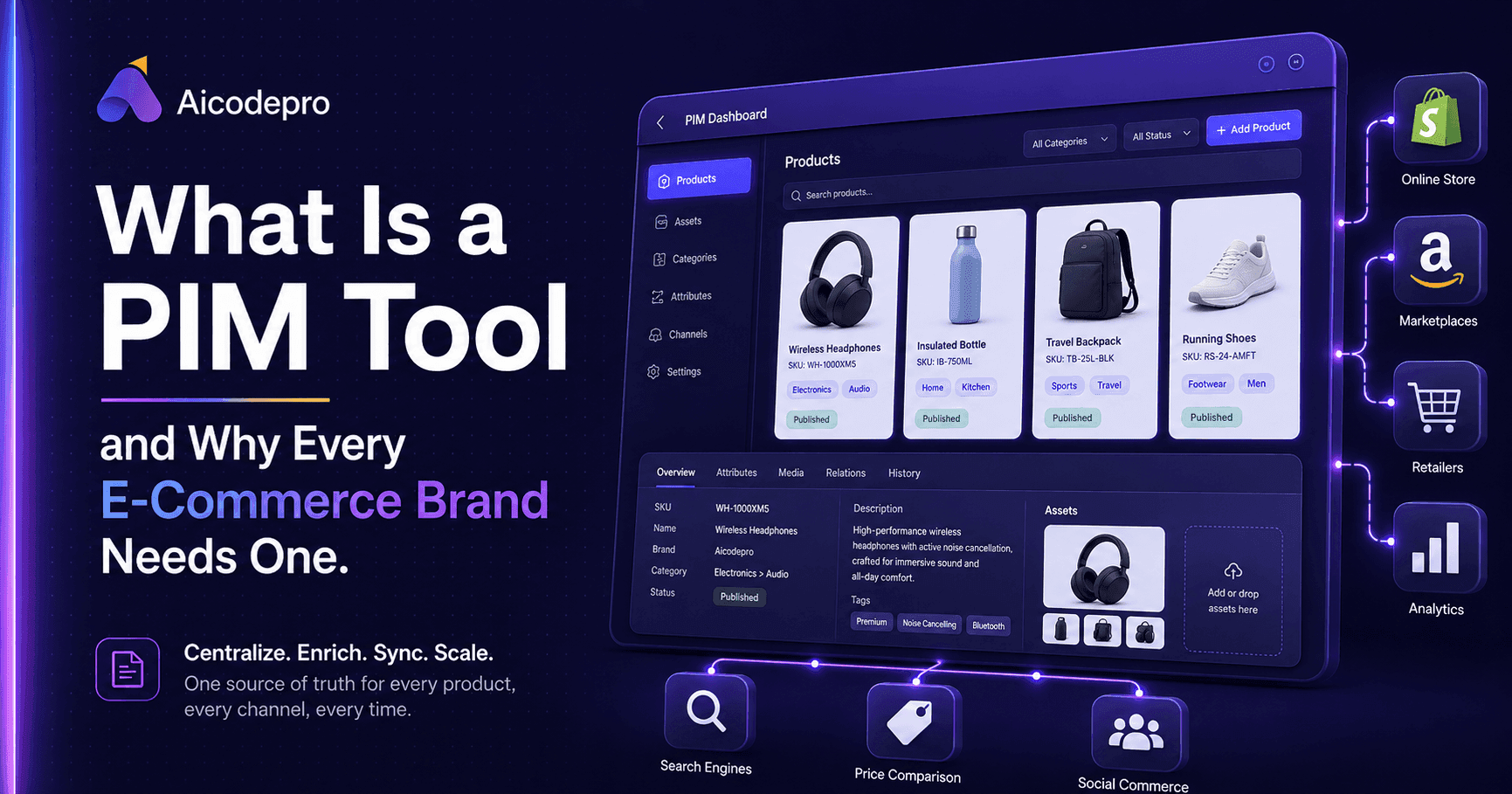
This is where a PIM tool for e-commerce becomes essential. A Product Information Management tool gives your brand a single, reliable place to create, manage, and distribute accurate product data across every sales channel, all at once.
What Is a PIM Tool for E-Commerce?
A PIM tool (Product Information Management tool) is software that centralizes all your product data titles, descriptions, images, SKUs, pricing, attributes, and SEO metadata into one system. It helps e-commerce brands manage large product catalogs more accurately, update listings faster, and push consistent product information across multiple sales channels.
Why E-Commerce Brands Struggle Without a PIM System
Most e-commerce teams start with spreadsheets. For a catalog of 20 or 30 products, that works fine. But as your catalog grows, spreadsheet-based product data management starts to break down fast.
Here is what typically goes wrong:
Product data stored in multiple spreadsheets — different versions in different folders, no single source of truth
Teams working from outdated information — marketing, operations, and sales all using different product descriptions
Manual catalog updates — changing one SKU means updating it across three or four systems by hand
Incorrect product descriptions — content errors that reach the storefront and mislead customers
Poor SEO metadata — missing or thin meta descriptions and titles that hurt search rankings
Slow marketplace uploads — time-consuming to format and push product data to Amazon, Flipkart, or other platforms
Inconsistent images and attributes — different image sizes, missing specs, or mismatched attributes across channels
High risk of errors at scale — every new product added manually increases the chance of mistakes
These are not just operational headaches. They cost you sales, hurt your search rankings, and damage customer trust.
Benefits of a PIM Tool for E-Commerce
The benefits of PIM for e-commerce go well beyond just keeping your data tidy. A well-implemented PIM solution changes how your entire product organization operates.
Centralized product data management Every team marketing, catalog, operations, content works from one system. No more version conflicts or missing files.
Better product data accuracy Built-in validation rules, required fields, and approval workflows catch errors before they go live. Your listings stay accurate across every channel.
Faster product launches When your product data is already structured and enriched, publishing to a new channel takes hours instead of days.
Consistent listings across channels Your Shopify store, your marketplace listings, and your wholesale portal all show the same accurate, up-to-date product information.
Improved SEO performance Structured product data with complete metadata, optimized titles, and keyword-rich descriptions improves how your products rank on Google and AI-driven search engines.
Easier catalog management Bulk editing, bulk uploads, and centralized media management make it faster to maintain large product catalogs without adding headcount.
Better customer experience Customers who see accurate, detailed, and consistent product information are more likely to trust your brand and complete a purchase.
Reduced manual work Automation handles repetitive tasks like formatting, syncing data across channels, and updating product content at scale.
Improved team collaboration Everyone works in the same system, with clear ownership and approval stages for product content.
Scalability for growing brands Whether you are managing 500 SKUs or 50,000, a PIM system for online stores grows with your business without losing control.
How a PIM Tool Improves Product Data Accuracy
One of the most immediate and measurable benefits of using PIM software for e-commerce is a sharp reduction in product data errors.
Here is how it works in practice:
Structured data fields ensure every product has a title, description, category, image, and SEO metadata before it can be published
Validation rules flag missing or incorrect information automatically for example, a product without a weight field cannot be saved
Required fields ensure no product goes live with incomplete attributes
Image management gives your team one place to upload, resize, and tag digital assets, so the right images always go with the right products
SEO metadata fields prompt teams to add optimized titles and descriptions at the product level, not as an afterthought
Approval workflows ensure that product content goes through a review stage before it is published to your store or sent to a marketplace
The result is a catalog where product data accuracy in e-commerce becomes the norm, not the exception.
PIM Tool vs Spreadsheet: What's the Difference?
Spreadsheets are a natural starting point for managing product data. They are free, familiar, and flexible. But they were not designed for e-commerce catalog management at scale.
Feature | Spreadsheet | PIM Tool |
|---|---|---|
Centralized data | No | Yes |
Multi-user collaboration | Limited | Yes |
Validation rules | No | Yes |
Channel-ready formatting | No | Yes |
Image management | No | Yes |
SEO metadata fields | No | Yes |
Bulk editing | Limited | Yes |
Error prevention | No | Yes |
Scalability | Poor | Strong |
A spreadsheet works when you have 30 products and one person managing them. A PIM system for online stores becomes essential when you have hundreds or thousands of SKUs, multiple team members contributing to product content, and several sales channels to keep in sync.
The risk is not just inefficiency. It is accuracy. A single wrong value in a shared spreadsheet can propagate errors across your entire catalog before anyone notices.
Who Needs a PIM Tool?
Any e-commerce brand managing more than a few dozen SKUs will benefit from a product catalog management system. But some industries and business types feel the need most acutely:
Fashion brands managing seasonal collections with multiple variants (size, color, fit)
Jewellery brands with complex material, weight, and certification attributes
Beauty and skincare brands with ingredient lists, regulatory data, and shade variants
Electronics sellers managing detailed technical specifications and compatibility data
Home decor brands with large image libraries and room-specific product attributes
Multi-category e-commerce stores handling diverse product types across many departments
Shopify stores scaling from a few products to hundreds or thousands of SKUs
Marketplace sellers distributing product listings across Amazon, Flipkart, Meesho, or other platforms
Agencies managing multiple client catalogs who need structured workflows and clear data ownership
If your team spends significant time correcting product data, updating listings manually, or reconciling different versions of product information — a PIM tool is the right solution.
How AiCodePro Helps E-Commerce Brands With PIM
AiCodePro is built for e-commerce brands that want to manage their product data more intelligently and grow their visibility across search, marketplaces, and AI-powered discovery platforms.
Here is how AiCodePro supports your product data management needs:
Centralized product data management AiCodePro gives your team one platform to manage product content, metadata, and catalog structure — no more chasing spreadsheets across departments.
AI-powered product content creation Generate optimized product titles, descriptions, and metadata at scale using AI. Reduce the time your content team spends on manual writing while improving quality and consistency.
SEO-friendly product titles and descriptions AiCodePro helps you create product content that is structured for both Google search and AI-powered discovery engines, improving your visibility across traditional and emerging search platforms.
Product metadata management Manage SEO titles, meta descriptions, alt text, schema markup, and structured data fields — all within your product workflow, not as a separate process.
Faster bulk updates Update product attributes, descriptions, or pricing across your entire catalog without opening a spreadsheet. Bulk editing tools let your team move faster without sacrificing accuracy.
Better discoverability through SEO, GEO, and AEO optimization AiCodePro goes beyond basic SEO. Its GEO (Generative Engine Optimization) and AEO (Answer Engine Optimization) capabilities help your products appear in AI-generated search results, voice search, and featured snippets — giving your brand visibility where traditional tools fall short.
Support for product content workflows Set up approval stages, assign content tasks, and track the status of product enrichment projects across your team.
AiCodePro is designed for brands that want to stop managing product data reactively and start scaling it strategically.
Final Thoughts
Product data is the foundation of every successful e-commerce operation. When it is accurate, consistent, and well-structured, everything else becomes easier — your listings convert better, your SEO performs stronger, your team works faster, and your customers trust your brand more.
A PIM tool for e-commerce is not a luxury for enterprise brands. It is a practical investment for any growing brand that wants to scale its catalog without scaling its chaos. The longer you rely on spreadsheets and manual processes, the more costly the errors become — in time, in conversions, and in customer confidence.
The brands that win on Google, on marketplaces, and across AI search platforms are the ones with the most accurate, enriched, and consistently managed product data. A modern PIM solution makes that possible.
Ready to Scale Your Product Catalog With Confidence?
Ready to simplify product data management and scale your e-commerce catalog faster? Explore AiCodePro's AI-powered PIM and product content solutions to make your store search-ready, AI-ready, and growth-ready.
Share with AI
Summarize this article, answer my questions based on it, and help me understand the key insights with your favorite AI assistant.