What Is a Free AI Visibility Audit, and What Does It Actually Check?
A free AI visibility audit checks how your brand appears across AI search engines and answer platforms, analyzing mentions, citations, content visibility, authority, and gaps that may affect how often AI recommends your business.
Aicodepro Team
VERIFIED AUTHOR
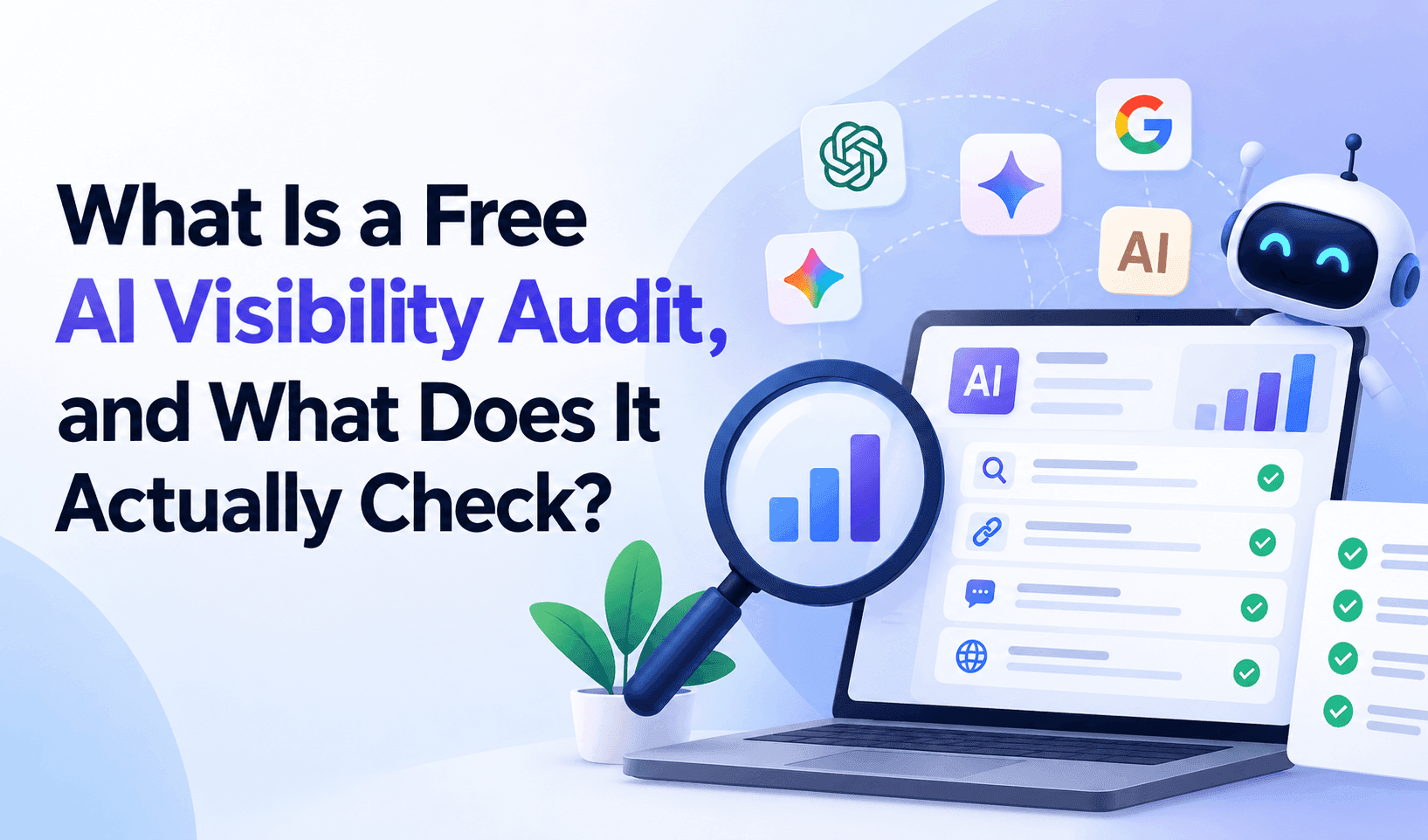
A free AI visibility audit checks whether AI tools like ChatGPT, Gemini, Perplexity and Google's AI Overviews can find your brand, describe it correctly, and recommend it when someone asks a relevant question. It looks at signals AI systems actually rely on — how consistently your brand is described across the web, whether your structured data is machine-readable, whether other sites mention you, and whether your content directly answers the questions buyers are asking — rather than just how well a page ranks on a results page.
If you've never had one run on your site, the short version is this: most businesses are invisible to AI assistants in ways their Google ranking doesn't reveal. You can be on page one of Google and still never get mentioned when someone asks ChatGPT "what's a good [your category] brand" — because the two systems are answering different questions using different evidence. This post walks through exactly what an AI visibility audit checks, why each check matters, and what to do with the results.
Why This Is a Different Problem Than SEO
Classic SEO answers the question "will Google's algorithm rank this page well?" An AI visibility audit answers a different question: "when someone asks an AI assistant about this topic, does the assistant have enough clear, trustworthy, quotable information to mention this brand at all?"
Those two questions overlap, but they're not the same, and the gap between them is bigger than most site owners expect. Independent research has found that a large share of pages cited by AI assistants don't rank anywhere near the top of Google's results for the same query — and the reverse is also true: plenty of page-one Google results never get cited by AI tools at all. Ranking well is necessary but not sufficient. An AI visibility audit is built to find the specific reasons a brand gets skipped, even when its SEO fundamentals look fine.
Checks this | Regular SEO audit | AI visibility audit |
|---|---|---|
Keyword rankings on Google | ✅ core focus | Not the focus |
Site speed, mobile-friendliness, crawl errors | ✅ | ✅ still matters, but not the differentiator |
Whether ChatGPT/Gemini mention your brand for relevant prompts | ❌ | ✅ core focus |
Structured data (schema) consistency across pages | Partial, often skipped | ✅ core focus |
Brand name/contact info consistency site-wide | Rarely checked | ✅ core focus |
Third-party mentions and citations AI tools might draw from | ❌ | ✅ core focus |
Content structured to be directly quotable | Rarely scored | ✅ core focus |
What Does the Audit Actually Check? (In Detail)
1. Entity clarity — does the internet agree on who you are?
AI systems build an internal "entity" for every brand they know about — a working model of your name, what you do, who owns you, and how you relate to other named things (parent company, product lines, locations). When your own site contradicts itself — one page calls you "AiCodePro," another says "AiCode Pro," your schema lists two different phone numbers, your company name and product name are never formally linked — that entity stays fuzzy. A fuzzy entity is harder for an AI system to confidently mention, because confidently naming something and getting it wrong is exactly the kind of error these systems are tuned to avoid.
What the audit looks for specifically: name consistency across page titles, navigation, footer, and every schema block; a single set of contact details used everywhere; and an explicit machine-readable link between your company (the legal entity) and your product or brand (what customers actually search for).
2. Structured data health — can machines actually parse your pages?
Schema markup (JSON-LD, typically) is how you hand a machine-readable summary of a page directly to crawlers, rather than making them guess by parsing your visual layout. The audit checks whether your Organization, Product, Service and FAQPage schema blocks are present, valid, and free of leftover template placeholders — a surprisingly common failure mode where a page ships with unfilled bracketed text still live in production schema, which actively damages trust signals rather than helping them.
It also checks for conflicting schema — for example, one block describing your business as a generic "AI tools" company and another describing a specific eCommerce product suite, with nothing tying the two descriptions together. Machines don't resolve that ambiguity in your favor; they either pick one description arbitrarily or discount both.
3. Content answerability — do your pages actually answer the question?
AI systems tend to quote content that answers a question directly, early, in a self-contained way. A page that opens with three paragraphs of brand story before it gets to the actual answer is harder to extract a clean quote from than a page that answers the question in the first 100–150 words and backs it up afterward. The audit reviews your key pages for this structure: is the direct answer up front, are headings phrased the way people actually ask questions, are paragraphs short enough to quote in isolation, and is there a genuine FAQ section (not a placeholder) with matching schema.
4. Off-site presence — what does the rest of the internet say about you?
This is the check most businesses aren't expecting, and it's arguably the most important one. AI answers draw heavily on third-party sources — independent write-ups, directory listings, comparison and "best of" pages, review sites, and community discussion — not primarily on what a brand says about itself. Research from AirOps analyzing over 21,000 brand mentions across ChatGPT, Claude and Perplexity found that the large majority of those mentions came from third-party domains, not the brand's own site. If your brand has strong on-site content but almost no independent presence elsewhere, the audit will flag that gap, because it's often the single biggest lever for improving AI visibility — bigger than anything you can fix on your own site alone.
5. Technical accessibility — can AI crawlers actually reach your content?
Separate from ranking, this checks the basics that determine whether your content is reachable at all: whether your robots.txt correctly permits the crawlers that feed AI systems, whether your sitemap is complete and correctly referenced, whether pages return the right HTTP status codes, and whether critical content is rendered in a way that a crawler (not just a browser) can read.
How to Run Your Free AI Audit
Go to the Free AI Audit page and enter your website URL.
Submit the form. (Confirm here whether an email address is required before results are shown — this was flagged as unverified in the site's internal Phase 0 review, and needs to be accurate in the published post.)
Read the results against the five checks above, not just the top-line score — the category breakdown tells you where to focus.
Prioritize fixes in this order: entity and schema consistency first (fastest to fix, foundational to everything else), then content answerability, then off-site presence (slowest to move, but the highest-leverage over time).
Re-run the audit after each round of fixes to confirm the change actually registered, rather than assuming it worked.
A Worked Example: What "Fuzzy Entity" Actually Looks Like
To make this concrete: imagine a site where the homepage Organization schema names the brand one way, the LocalBusiness schema lists a different phone number than the contact page, and the page <title> never mentions the brand name at all — just a generic product description. None of these are catastrophic on their own. Together, they mean an AI system has no single, confident, consistent answer to "what is this company, and how do I reach them" — so when a user asks about that category, the system reaches for a competitor whose signals are cleaner, even if that competitor's actual product is comparable or weaker. This is the exact failure mode the entity-clarity check is designed to catch.
Share with AI
Summarize this article, answer my questions based on it, and help me understand the key insights with your favorite AI assistant.