
How to Write Content That AI Assistants Actually Quote
A practical, structure-first guide to writing content AI assistants will actually pull into their answers, not just index.
Aicodepro Team
VERIFIED AUTHOR
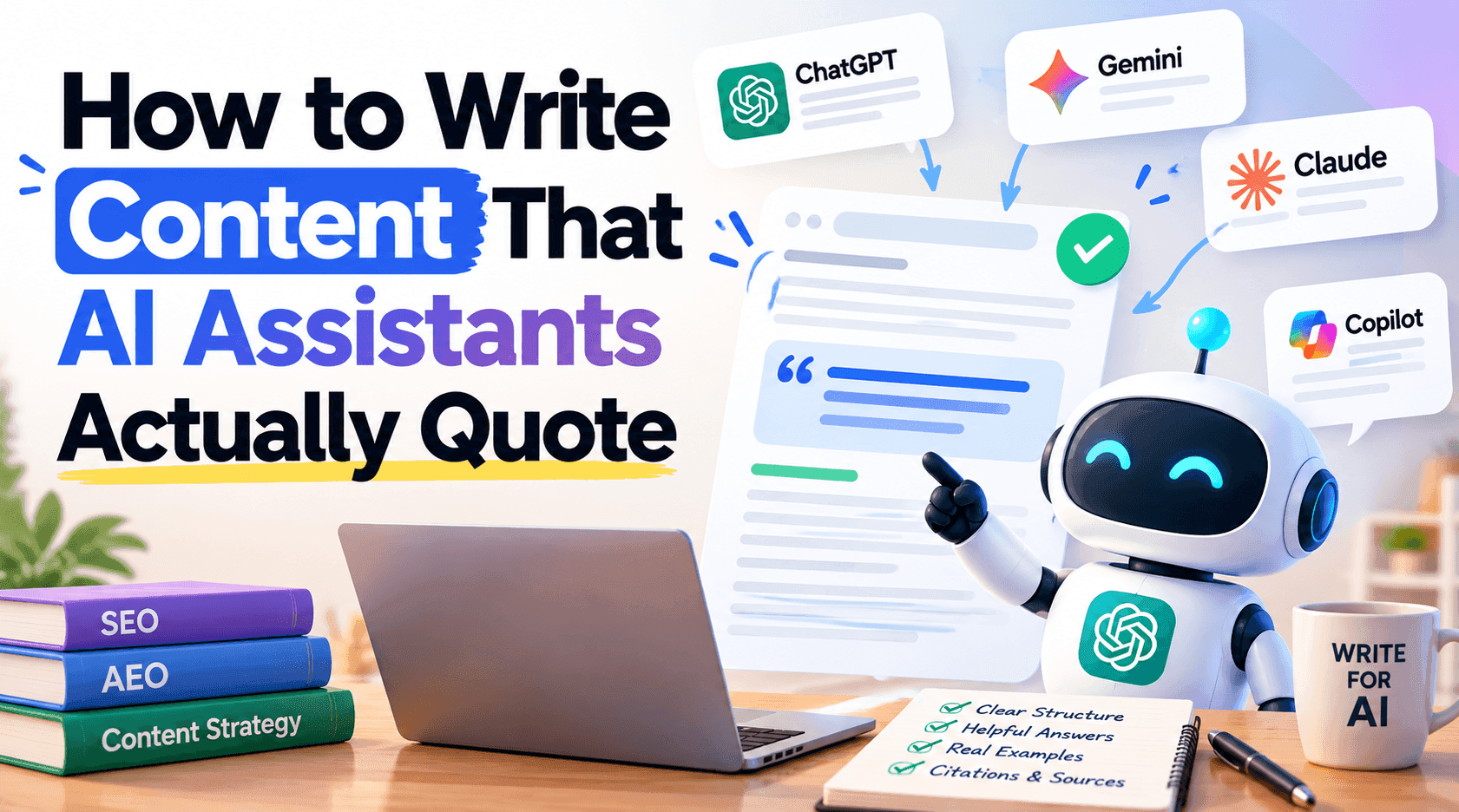
Two pages can say the same true thing, and only one of them gets quoted by ChatGPT. That's not usually a ranking problem or an authority problem. It's a structure problem. AI assistants extract answers the way a tired person skims a page at 11pm: they want the direct answer near the top, in a chunk they can lift without editing, not buried under three paragraphs of scene-setting. If you're wondering how to write content ai will cite instead of content that just sits there indexed and ignored, the fix is almost always structural before it's ever about the facts themselves.
Key Takeaways
Learning how to write content AI will cite starts with the first 100 to 150 words, not after a story, a definition of the category, or a paragraph of throat-clearing.
Short, self-contained paragraphs quote cleanly. A 40 to 80 word paragraph that makes sense pulled out on its own is exactly what an AI system is looking to lift.
Question-style headings match how people actually prompt AI assistants, which is closer to natural language than to keyword strings.
Every number needs its context attached: source, date and sample size, right next to the figure, not in a footnote three screens away.
Tables and numbered steps get pulled into AI answers far more often than dense paragraphs, because they're already pre-structured for extraction.
A real FAQ section with matching schema gives an AI system a pre-packaged question-and-answer pair it doesn't have to construct itself.
Internal links to your own supporting pages signal that a claim has depth behind it, not just a single unsupported sentence.
None of this guarantees a citation. It raises the odds by removing the friction that stops an AI system from lifting your content even when it's accurate.
Why "How to Write Content AI Will Cite" Is a Structure Question First
Search engines have always rewarded pages that eventually answer the question. AI assistants are less patient than that. They're assembling an answer in real time from fragments across multiple sources, and a fragment that requires interpretation, that's split across two paragraphs, or that's wrapped in marketing language before it gets to the point, is simply more expensive to use than a fragment that's already clean.
This is why a technically accurate page can lose out to a thinner, less authoritative one that happens to be better organised. The AI system isn't judging which source is more trustworthy in some abstract sense during extraction. It's picking up the pieces that are easiest to lift cleanly.
The Gap Between Ranking and Being Quoted
A page can rank on page one of Google for a query and never once appear in an AI-generated answer for that same query. The two systems are solving different problems: one is retrieving and ordering full documents, the other is extracting and recombining fragments. Writing for extraction is a distinct skill from writing for ranking, even though good content usually does both at once when it's built the right way from the start. This is the core of how to write content ai will cite consistently, not just occasionally.
How to Write Content AI Will Cite: Start With the First 150 Words
This is the single highest-leverage change most pages need. If your opening paragraph spends its first sentences setting the scene, defining the category, or building up to the point, you've already lost the extraction window. Put the direct, complete answer in the first 100 to 150 words. Everything after that is support, nuance and context, and it can come in whatever order makes sense for a human reader.
What "Direct" Actually Means Here
Direct doesn't mean short and thin. It means the reader (or the AI system extracting on their behalf) doesn't have to read three more paragraphs to find out what you actually think. State the answer, then justify it. Don't make justification a prerequisite for stating it.
Structure Paragraphs So a Single One Can Stand Alone
Aim for paragraphs in the 40 to 80 word range that make complete sense if someone quoted just that one paragraph, with nothing before or after it. That's a genuinely different writing habit than the flowing, multi-sentence-dependent paragraphs most long-form content defaults to, where sentence three only makes sense because of sentence one.
Read back anything you've written and ask: if an AI system lifted only this paragraph, would it be a complete, accurate answer, or would it be a fragment that needs the rest of the page to make sense. If it's the second one, split it.
Use Question-Style H2 Headings
Headings phrased the way people actually ask questions ("What is...", "How much does...", "Is it worth...") do double duty. They match the phrasing of real prompts, and they make each section skimmable as its own self-contained unit, which is exactly the shape an AI system is scanning for when it's deciding what to extract.
Give Every Number Its Context, Right Next to It
A statistic without a source, date and sample size attached is a statistic an AI system has less reason to trust and reuse. "Source, date, sample" should sit in the same sentence as the number itself, not in a citations list at the bottom of the page that gets separated from the figure during extraction.
An Example of the Difference
Compare "AI Overview citations from top-ranking pages dropped sharply" against "the share of AI Overview citations coming from Google's top 10 results fell from 76% to 38%, according to an Ahrefs study of 863,000 keywords and 4 million AI Overview URLs, reported in March 2026." The second version is extractable on its own. The first version needs the rest of the article to mean anything.
Use Tables and Numbered Lists Wherever You're Comparing or Sequencing
Tables and numbered steps are already pre-structured for extraction, which is exactly why they show up disproportionately often inside AI-generated answers. If you're comparing two options, a table forces you to state the comparison cleanly instead of describing it in prose that an AI system has to reconstruct into structured form itself. If you're describing a process, numbered steps do the same job.
Where This Matters Most
Any "X vs Y" post, any step-by-step guide, and any pricing or feature breakdown should default to a table or numbered list as the primary format, not as a bonus visual added after the prose is finished.
How Much Structure Is Too Much
Tables and lists that break up genuinely continuous reasoning, rather than a real comparison or sequence, read as mechanical rather than helpful. Use them where the content is naturally tabular or sequential, not as a formatting habit applied everywhere.
Write a Real FAQ Section, Not a Placeholder
A genuine FAQ section, with four to six questions actually answered on the page and matching FAQPage schema, hands an AI system a pre-packaged question-and-answer unit it doesn't have to build itself. This only works if the questions are ones people actually ask and the answers are complete on their own. A placeholder FAQ with an unfilled template question is worse than no FAQ at all, since it signals structured content that isn't actually there.
How to Write Content AI Will Cite: Link to the Sources Behind Every Claim
Internal links to your own supporting content, the pages, guides or data sources that back up a specific claim, signal depth. A single unsupported sentence reads differently from a sentence with a clear trail back to where the claim comes from. This isn't about link volume for its own sake. It's about making sure a bold claim on one page is traceable to where it's actually explained.
Quick Checklist for Every New Post
Run through this checklist for how to write content ai will cite before you hit publish:
Does the first 100 to 150 words answer the title's question directly, with no scene-setting first?
Are paragraphs short enough that any single one could be quoted alone and still make sense?
Do at least three or four headings use question-style phrasing that matches how people actually ask AI assistants?
Does every statistic carry its source, date and sample size in the same sentence?
Is any comparison or step-by-step content built as a table or numbered list, not dense prose?
Is there a real FAQ section with matching schema, answering questions people actually ask?
Does the page link to the specific sources or pages that back up its claims?
Share with AI
Summarize this article, answer my questions based on it, and help me understand the key insights with your favorite AI assistant.