
AI-Powered Ecommerce Chatbots for Sales: How to Boost Conversions, AOV, and Cart Recovery
Learn how modern AI sales chatbots increase conversion rates by 25%, lift average order value, and recover abandoned carts with real-time PIM integration.
AicodePro Team
VERIFIED AUTHOR
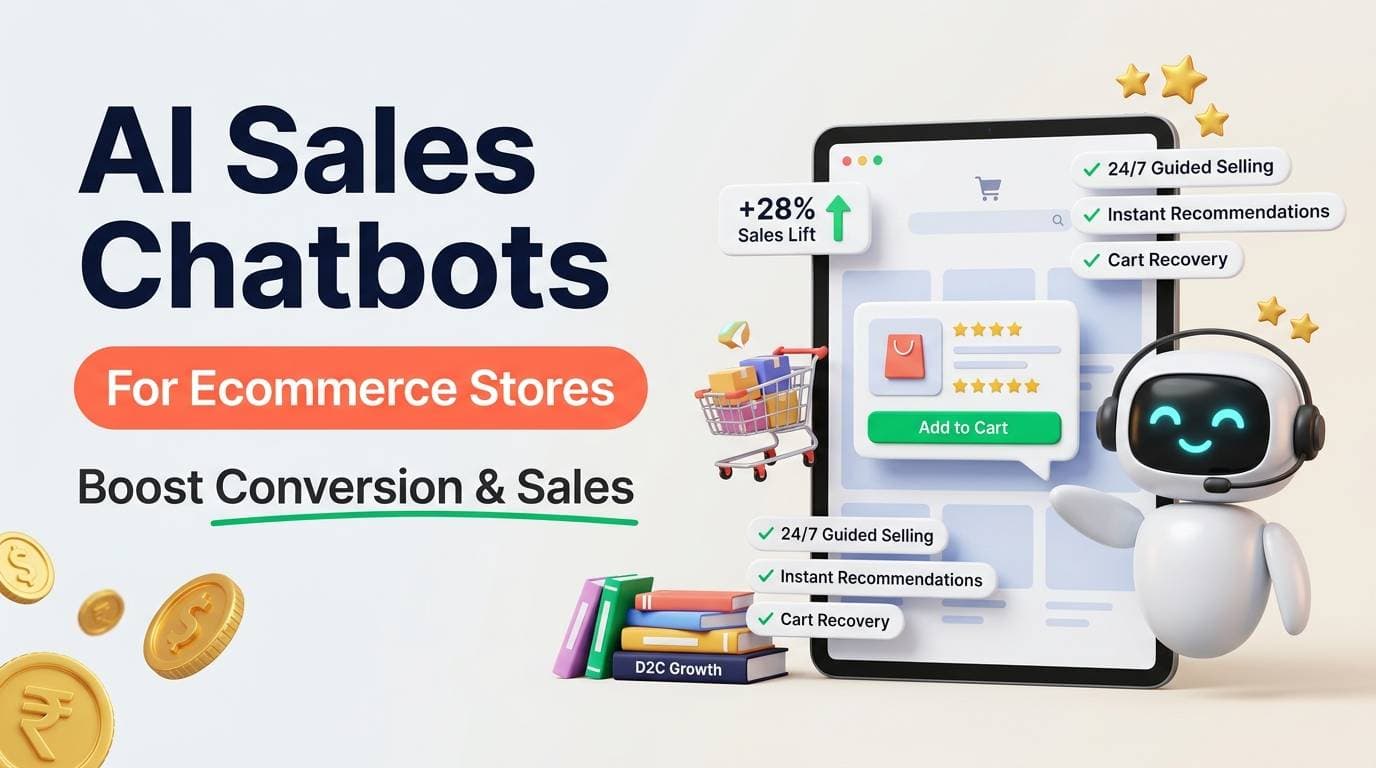
For years, online shoppers treated ecommerce chatbots as a nuisance. Scripted decision trees, rigid keyword matching, and endless loops of "I didn't quite catch that" created frustration rather than sales. Today, large language models, agentic workflows, and real-time Retrieval-Augmented Generation (RAG) have fundamentally rewritten conversational commerce. The chatbot has evolved from an irritating deflection widget into an intelligent, consultative AI sales assistant that replicates the high-touch expertise of a top-tier retail sales associate.
An ai-powered ecommerce chatbot for sales is an active revenue engine. By analyzing shopper intent in real time, answering nuanced product questions, personalizing recommendations from live inventory, and proactively rescuing abandoned carts, modern sales bots transform casual site visitors into high-value repeat customers.
This comprehensive playbook examines the economic mechanics of conversational selling, details the technical architecture needed for zero-latency catalog synchronization, and outlines a practical 4-week roadmap to deploy an AI sales assistant on your store.
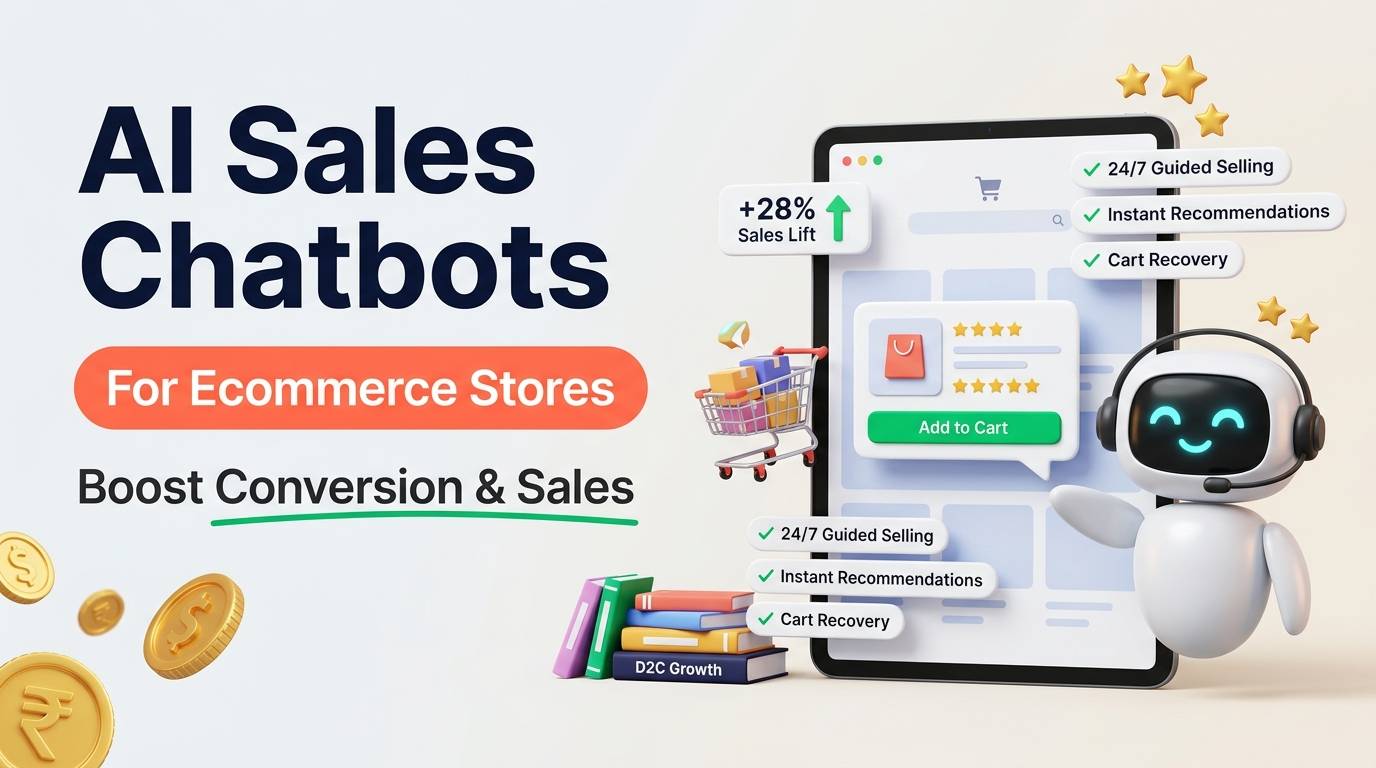 AI Sales Chatbots for Ecommerce Stores - Boost Conversion and Sales
Key Takeaways
- Consultative selling drives conversion: AI assistants guide shoppers through complex catalogs, answering nuanced questions to overcome purchase hesitation.
- Sub-second PIM and ERP integration: Connecting chatbots directly to live inventory prevents out-of-stock recommendations and pricing errors.
- Measurable financial impact: Top implementations achieve 15% to 30% chat conversion lifts and 10% to 20% higher Average Order Value (AOV).
- Proactive cart abandonment recovery: Context-aware triggers intervene when shoppers hesitate on shipping, sizing, or checkout steps.
- Vernacular language support: Conversing in local languages and dialects unlocks massive conversion gains across emerging e-commerce markets.
How AI Sales Chatbots Drive Direct Revenue
Unlike customer service bots whose success is measured by cost savings and ticket deflection, an AI sales assistant is evaluated as a profit center. It drives top-line revenue through four primary mechanisms:
1. Guided Product Discovery for Large Catalogues
When customers browse an ecommerce store with hundreds or thousands of SKUs, filter dropdowns and search bars frequently lead to choice overload. An AI sales assistant enables natural dialogue: "I need a non-greasy mineral sunscreen suitable for sensitive acne-prone skin that works well under makeup for under $35." The assistant evaluates product ingredients, matches customer criteria, and presents the top two recommendations with explicit justifications.
2. Intelligent Cross-Selling and Bundle Recommendations
Rather than relying on static, generic "Customers Also Bought" algorithms, an AI sales assistant understands situational context. If a customer is purchasing an espresso machine, the assistant explains which grind size and portafilter accessories match that specific model, calculating combined bundle discounts directly in the chat interface.
3. Real-Time Objection Handling
Over 70% of online cart abandonments occur due to unanswered questions at the moment of decision: "Will this shrink when washed?", "Is this compatible with USB-C?", "What is the warranty policy for international shipping?" By resolving these objections instantly on the product detail page, the assistant preserves buyer momentum.
4. Context-Aware Exit-Intent Intervention
When an assistant detects a shopper lingering on a high-value cart or moving to exit the page, it can trigger an empathetic, personalized intervention—offering an expedited delivery perk or answering shipping questions before the shopper leaves.
Evolution of Chatbot Architectures
| Capability | Legacy Rule-Based Bots | Basic NLP Chatbots | Modern Agentic Sales Assistants |
|---|---|---|---|
| Dialogue Handling | Rigid button menus & keyword trees | Basic intent classification | Fluid, multi-turn conversational reasoning |
| Catalog Awareness | None or static text links | Keyword search matching title text | Real-time PIM/ERP sync (stock, variants, live pricing) |
| Personalization | Zero context retention | Basic customer name substitution | Browsing journey, cart contents, customer tier, language |
| Checkout Integration | External static link | Redirect to cart page | In-chat 1-click cart addition, coupon application, checkout |
Technical Prerequisites for Real-Time Selling
To deliver an exceptional sales experience without risk of hallucinated discounts or out-of-stock recommendations, ensure your store meets these three technical requirements:
- Structured Product Information Management (PIM): Ensure attributes such as sizing charts, material specifications, compatibility matrices, and care instructions are maintained in structured database fields rather than trapped inside unsearchable image banners.
- Sub-400ms API Latency: Modern conversational flow demands near-instantaneous responses. The assistant's catalogue lookup microservices must query inventory caches with minimal latency.
- Strict RAG Guardrails: Confine the model's generation space strictly to approved product documentation and active promotions, completely eliminating speculative claims.
4-Week Implementation Roadmap
- Week 1 - Data Ingestion & Knowledge Base Setup: Ingest your complete product catalog, sizing guidelines, return policies, and shipping FAQs into a secure vector database. Configure brand tone and safety guardrails.
- Week 2 - High-Intent Pilot Testing: Launch the assistant on your top 20 revenue-driving product detail pages and complex category hubs. Monitor initial interaction quality.
- Week 3 - Cart Recovery & Checkout Integration: Enable direct in-chat cart addition and configure exit-intent triggers on the cart and checkout pages.
- Week 4 - Vernacular Localization & Full Scale: Enable regional language support, review conversation transcripts to uncover unaddressed customer objections, and deploy store-wide.
Conclusion & Next Steps with AiCodePro
As consumer expectations shift toward personalized, on-demand shopping guidance, static product pages are no longer sufficient. Deploying an AI sales assistant transforms your storefront into an engaging, high-converting digital showroom available 24 hours a day, 365 days a year.
Explore AiCodePro's ecommerce automation suite to learn how intelligent product data management, conversational AI, and search automation can drive sustained revenue growth for your online brand.
About the Author
The Aicodepro Team builds cutting-edge conversational AI platforms, Generative Engine Optimization tooling, and headless commerce automation systems for leading online retailers.
Share with AI
Summarize this article, answer my questions based on it, and help me understand the key insights with your favorite AI assistant.