
SEO-Optimized AI Website Builder: 2026 Ranking Guide
Discover the best SEO-optimized AI website builders in 2026. Compare Core Web Vitals, Schema markup, SSR performance, and AI search visibility features.
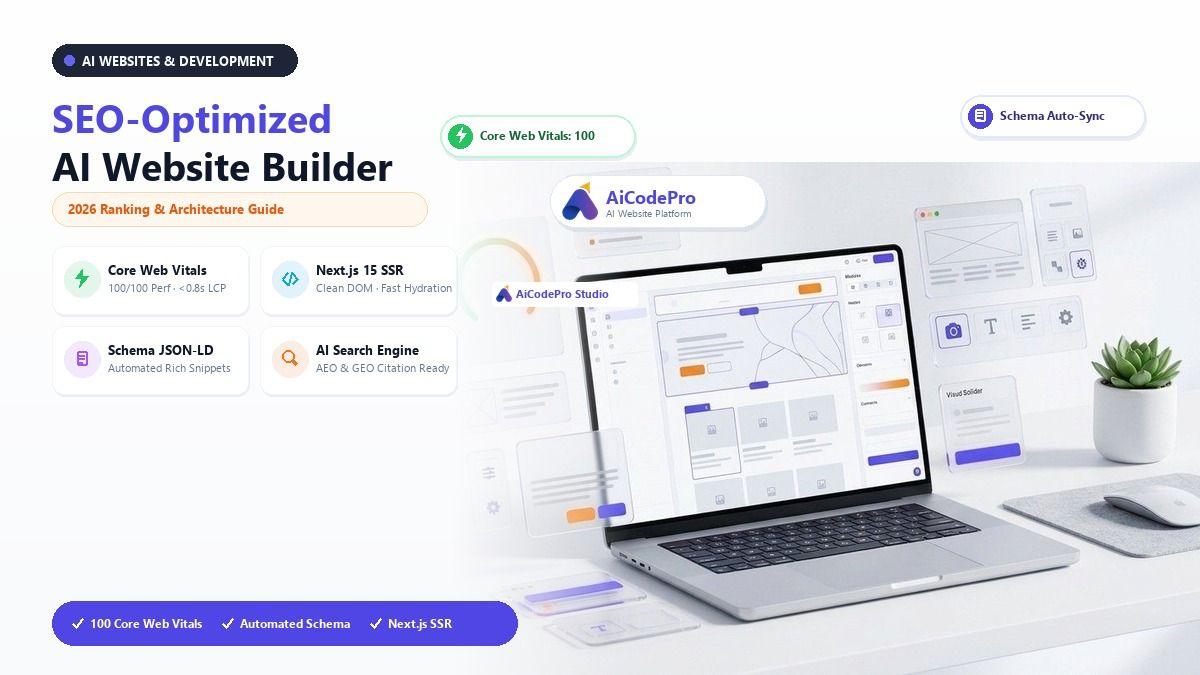
AI website builders promise instant design with a single prompt, but most generate bloated client-side code that fails Google's Core Web Vitals and disappears from search results. An SEO-optimized AI website builder combines prompt-driven design with server-side rendering, automated Schema.org markup, and generative search readiness to guarantee sustainable search visibility.
- Rendering Architecture Determines Rankings: Client-side rendered AI templates suffer from delayed hydration and slow LCP; modern SEO builders rely on Next.js server-side rendering (SSR) for instant indexing.
- Automated Structured Data: True SEO website builders automatically inject valid JSON-LD schemas for organizations, products, and FAQs without manual configuration.
- Generative Engine Optimization (GEO): Modern platforms generate
llms.txtfiles and clean text hierarchies to ensure AI models like ChatGPT and Perplexity quote your site. - Zero JavaScript Bloat: Stripping unnecessary runtime dependencies delivers 100/100 Lighthouse performance and flawless mobile viewport stability.
How an SEO-Optimized AI Website Builder Works
Bottom Line Up Front: An SEO-optimized AI website builder couples visual layout generation with enterprise-grade technical foundations. It automatically configures server-side rendering, semantic HTML hierarchies, JSON-LD knowledge graphs, and crawler directives so newly launched websites rank rapidly in both traditional search engines and AI answer engines.
The promise of artificial intelligence in web development has historically hit a major roadblock: technical search engine optimization. First-generation AI builders focused exclusively on visual aesthetics, outputting heavy single-page applications burdened with Megabytes of uncompressed JavaScript, deeply nested div structures, and missing server headers.
Search crawlers like Googlebot allocate a limited crawl budget to every domain. When a crawler encounters an un-optimized AI website, it must render heavy client-side scripts before discovering text content, leading to indexing delays and depressed search positions.
An SEO-first AI website builder flips this dynamic. When you describe your business or prompt the engine, it builds pages on high-performance frameworks like Next.js with static site generation (SSG) and server-side rendering (SSR). Content is served as pre-rendered HTML, allowing search engines to index primary keywords, headings, and internal links in milliseconds on the very first crawl pass.
The 5 Pillars of Technical SEO in AI Web Builders
To achieve top-tier rankings in 2026, an AI website builder must satisfy five foundational technical standards:
1. Server-Side Rendering & Core Web Vitals Mastery
Speed is a confirmed ranking signal. Google evaluates user experience through Core Web Vitals:
- Largest Contentful Paint (LCP): Must clock in under 2.5 seconds (top builders hit under 1.2s) by serving pre-optimized AVIF/WebP imagery from distributed CDNs.
- Interaction to Next Paint (INP): Stays below 200 milliseconds by eliminating blocking third-party scripts.
- Cumulative Layout Shift (CLS): Remains under 0.1 by reserving explicit width and height dimensions for all media containers.
2. Automated Schema.org Structured Data Graphs
Structured data is the primary bridge between your website and search algorithms. Instead of requiring webmasters to manually write JSON-LD code, an advanced builder automatically maps:
OrganizationandLocalBusinessdata with verified geographic coordinates and operating hours.ProductandOfferschema with real-time price currency and inventory status.BreadcrumbListandArticleschema for clear site hierarchy and author attribution.
3. Dual-Index & Generative Engine Optimization (GEO) Readiness
In 2026, over 40% of commercial product research begins in conversational AI assistants. An SEO-optimized builder does not merely optimize for Google's ten blue links; it formats content into modular semantic blocks that language models like ChatGPT, Perplexity, and Claude ingest effortlessly. It also natively outputs an llms.txt file at the domain root, providing AI search agents with a structured roadmap of your authoritative documentation.
4. Semantic Hierarchy & Clean DOM Depth
Standard drag-and-drop builders often nest elements 25 to 35 layers deep, exhausting crawler parsers. An SEO-optimized builder outputs clean, semantic HTML5 elements (<header>, <main>, <article>, <section>, <footer>) with a maximum DOM depth under 12 layers. It strictly enforces a single H1 tag per page, followed by logical H2 and H3 subheadings.
5. Automated robots.txt and XML Sitemap Maintenance
As your site grows, the platform automatically maintains an accurate sitemap.xml and permissions file. It ensures search engines access revenue-driving landing pages while keeping administrative staging paths protected. You can inspect or build custom crawler instructions using our free Robots.txt Generator.
Technical Comparison: Legacy AI Builders vs. SEO-First Builders
Before committing to a website building platform, compare the underlying architectural differences that dictate ranking success:
| Technical Feature | Legacy Visual AI Builders (Wix, Squarespace) | SEO-Optimized AI Builders (AiCodePro Web Builder) | Real-World Search Impact |
|---|---|---|---|
| Rendering Engine | Client-Side Hydration (CSR) with heavy JS bundles | Next.js Server-Side Rendering (SSR) / Static SSG | Eliminates Googlebot rendering queues; pages index within hours. |
| Average Mobile LCP | 3.8s – 5.2s (Fails Core Web Vitals) | 0.9s – 1.4s (Passes in green zone) | Boosts mobile rankings and slashes bounce rates by up to 40%. |
| Schema Generation | Basic metadata; requires manual third-party plugins | Native automated JSON-LD knowledge graphs | Qualifies for Google Rich Snippets and carousel listings. |
| AI Search Optimization | None; blocks AI crawlers or serves unparsed JS | Native llms.txt, GEO semantic blocks, bot whitelisting | Secures direct brand citations in ChatGPT Search & Perplexity. |
| DOM Tree Cleanliness | Deep nested divs (>30 levels); heavy DOM bloat | Semantic HTML5 structure (<12 levels deep) | Drastically improves crawler efficiency and page scroll speed. |
| Meta Tag Enforcement | Loose character limits; frequent truncation | Strict SERP title (50–60 chars) & meta (140–155 chars) rules | Maximizes organic click-through rates (CTR) on search pages. |
To verify your page titles, descriptions, and Open Graph previews before deploying, use our free Meta Tag Generator.
Critical Core Web Vitals Audit Checklist for AI-Built Websites
Before publishing any AI-generated page to production, verify each item against this technical performance checklist:
- Image Optimization Pipeline: Ensure all hero banners and product graphics are compressed to modern WebP or AVIF formats. Images above the fold should never use lazy-loading (
loading="eager"), while below-the-fold media must defer loading. - Font Loading Performance: Utilize modern
font-display: swapdeclarations and self-hosted variable font files. Eliminate render-blocking Google Fonts stylesheets that introduce flash of invisible text (FOIT). - Script Deferral & Minification: Defer all analytical trackers, live chat widgets, and marketing pixels so the main execution thread remains completely idle during initial DOM parsing.
- Server Response Time (TTFB): Ensure edge hosting infrastructure delivers a Time to First Byte under 300 milliseconds worldwide via globally distributed edge CDNs.
- Mobile Touch Targets & Accessibility: Verify tap targets maintain a minimum size of 48 by 48 CSS pixels with sufficient spacing to eliminate mobile interaction errors.
Common Mistakes When Building Websites with AI
Founders and marketing agencies frequently stumble into four critical pitfalls when deploying AI-generated websites:
- Publishing Generic AI Copy Without Information Gain: Using default prompt responses produces lookalike copy that triggers Google's helpful content classifiers. Always inject proprietary data, customer case studies, and concrete numerical examples.
- Neglecting Mobile Viewport Verification: AI builders often arrange elements beautifully on wide desktop screens while allowing horizontal overflow or tiny font sizes on mobile devices.
- Ignoring Image Optimization and Next-Gen Formats: Uploading raw 4MB camera files drags down page performance. An optimized builder automatically resizes, converts to WebP, and applies lazy-loading to below-the-fold assets.
- Failing to Track AI Search Visibility: Monitoring only desktop keywords leaves you blind to conversational search trends. Use tools like the AiCodePro Ranker to audit visibility across Google AI Overviews, Perplexity, and ChatGPT.
How to Launch an SEO-Dominant Website in 4 Steps
Building a high-ranking digital footprint no longer requires months of manual code development:
- Step 1: Define Core Entity & Business Architecture
Outline your core service categories, target locations, and primary search intent. - Step 2: Generate Pre-Rendered Pages with AiCodePro
Deploy your layout using an engine engineered specifically for search performance and high-converting user journeys. - Step 3: Audit Technical Foundations & Bot Directives
Verify that your sitemap is submitted in Google Search Console and that verified bots can crawl your content cleanly. Learn more about how modern search algorithms index dynamic content in our Google AI Overviews Optimization Guide. - Step 4: Seed Authoritative Citations & Reviews
Connect your Google Business Profile and distribute industry press releases to build entity trust across search and AI systems.
Build Your Next High-Ranking Website with AiCodePro
In the competitive landscape of 2026, launching a website that looks good is only half the battle. If your platform cannot pass Core Web Vitals, deliver structured schema, and feed conversational AI search engines, prospective customers will simply choose your competitors.
Ready to build a blazing-fast, search-dominant web presence in minutes? Explore the AiCodePro AI Website Builder to experience prompt-driven design backed by high-speed Next.js architecture and built-in search optimization.
Share with AI
Summarize this article, answer my questions based on it, and help me understand the key insights with your favorite AI assistant.
Frequently asked questions
Yes. Google evaluates content based on helpfulness, originality, and user experience (Core Web Vitals), regardless of whether it was assisted by AI. Websites built on pre-rendered frameworks with fast server-side rendering, valid Schema.org structured data, and original insights rank competitively against hand-coded sites.
Most drag-and-drop AI builders rely on client-side rendering (CSR), which requires search crawlers to download and execute heavy JavaScript bundles before seeing text. This causes high Largest Contentful Paint (LCP) times and crawl budget exhaustion. They also often produce bloated DOM hierarchies with over 30 nested layers.
Standard SEO optimizes for Google's organic blue links using keywords and backlinks. Generative Engine Optimization (GEO) structures website content into clear entity blocks and machine-readable llms.txt files so conversational AI engines like ChatGPT, Perplexity, and Google AI Overviews cite and recommend your business in direct answers.
Server-side rendering delivers fully constructed HTML from the server directly to the browser or search bot on initial request. This eliminates rendering queues for search crawlers like Googlebot, ensures instantaneous content indexing, and drastically improves Core Web Vitals like LCP and INP.