
SEO, AEO, & GEO: The 2026 Hybrid Strategy for Search Dominance
This guide explores the shift from traditional SEO to a hybrid 2026 strategy, ensuring your content isn't just indexed, but cited and summarized by the world's most powerful AI models.
Sumit Joshi
VERIFIED AUTHOR
Introduction
For years, SEO was a game of keywords and "blue links." In 2026, that game has changed. With the integration of AI Overviews (SGE) and the rise of Generative AI search (ChatGPT, Gemini, Perplexity), ranking #1 on Google is no longer the final goal. To stay visible, your brand must now master AEO (Answer Engine Optimization) and GEO (Generative Engine Optimization).
What is AEO (Answer Engine Optimization)?
AEO is the practice of optimizing content to be the immediate answer to a user’s query. It focuses on "Zero-Click" searches—where a user gets the answer directly on the search page without clicking a link.
Core Targets for AEO:
- AI Overviews: The synthesized summaries at the top of Google.
- Featured Snippets: The "Position Zero" block.
- Voice Search: Direct verbal answers from Alexa, Siri, and Google Assistant.
- People Also Ask (PAA): The drop-down accordion questions.
What is GEO (Generative Engine Optimization)?
While AEO targets the answer, GEO targets the source. GEO is the process of making your content "AI-readable" so that Large Language Models (LLMs) like Claude or ChatGPT use your data as a foundational citation.
SEO vs. GEO: Key Differences for 2026
While traditional SEO and Generative Engine Optimization work together, they focus on different parts of the user journey. Here is a breakdown of how they differ:
1. Primary Goal
- Traditional SEO: Focuses on ranking your website in the top 10 positions of Search Engine Results Pages (SERPs) to drive organic clicks and traffic.
- GEO (Generative Optimization): Focuses on getting your content cited, mentioned, or summarized within AI-generated responses (like ChatGPT, Gemini, or Google’s AI Overviews).
2. Content Style and Structure
- Traditional SEO: Favors long-form, narrative-heavy articles (1,500+ words) designed to keep a human reader engaged on the page.
- GEO (Generative Optimization): Favors "chunked," fact-dense content. It prioritizes direct answers in the first 50 words and uses surgical snippets that an AI model can easily lift and reuse.
3. Key Success Metrics
- Traditional SEO: Measured by Click-Through Rate (CTR), organic sessions, keyword rankings, and bounce rate.
- GEO (Generative Optimization): Measured by Citation Frequency, "In-Answer Presence," and brand mentions within the AI's conversational output.
4. Technical Focus
- Traditional SEO: Centers on meta tags, XML sitemaps, and Core Web Vitals (speed and mobile-friendliness).
- GEO (Generative Optimization): Centers on Schema Markup (JSON-LD), explicit entity linking, and creating "machine-readable" endpoints that AI crawlers can parse without distraction.
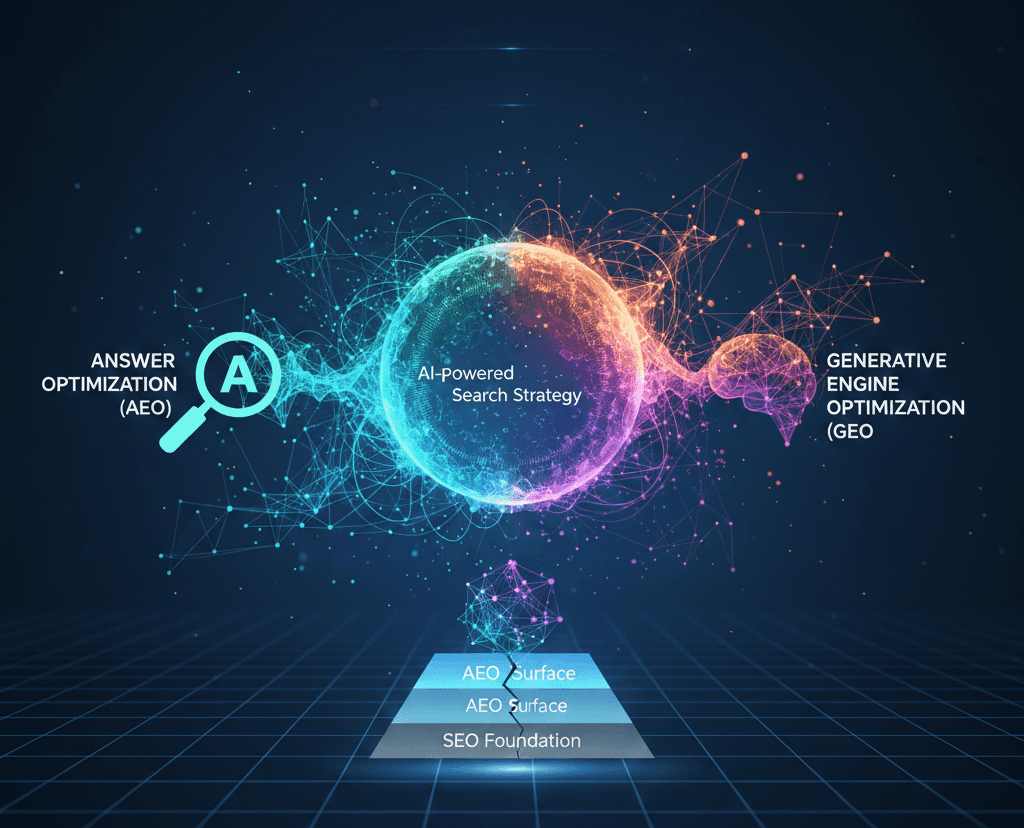
The 2026 Hybrid Strategy: SEO + AEO + GEO
You cannot choose one; you need all three. Think of them as layers of a pyramid:
- SEO (The Foundation): Technical health, site speed (Core Web Vitals), and mobile-first design.
- AEO (The Surface): Question-based headers and schema markup for instant answers.
- GEO (The Depth): Semantic topical hubs that prove your brand is a "subject matter expert."
Actionable Checklist: How to Optimize for AI Search
1. Master the "Answer-First" Structure (AEO)
Google’s AI prefers content it can extract in seconds.
- The 50-Word Rule: Use your H2 or H3 as a question (e.g., "What is GEO in SEO?") and provide a direct, factual answer in the very next 40–60 words.
- Use FAQ Schema: Implement "FAQPage" JSON-LD markup to tell Google exactly where your answers are.
2. Build Semantic Content Clusters (GEO)
AI models look for "Entity" relationships. Don't just write a blog; build a Topic Hub.
- Pillar Pages: Create a master guide on a broad topic.
- Cluster Content: Link to 5–10 sub-topic articles. This internal linking helps AI understand the "web of knowledge" you provide.
3. Enhance E-E-A-T Signals
To be a "trusted source" for an LLM, you must prove you are real.
- Author Transparency: Every post should have a clear author bio with credentials and social links.
- Cite Primary Sources: Link to original research, government data, or whitepapers. AI favors "verified" information.
4. Technical Readiness for 2026
- llms.txt: Consider adding an llms.txt file to your root directory to help AI crawlers find your best "citation-worthy" content.
- Speed: Ensure your Largest Contentful Paint (LCP) is under 2.5 seconds. AI search engines prioritize sites that they can parse instantly.
Conclusion: Why This Matters for Your Brand Visiblity
In 2026, search is no longer a library; it’s a conversation. If your content isn't structured for AEO and GEO, you aren't just losing rankings—you're losing your voice in the AI-driven future. By implementing a hybrid approach today, you secure your brand's authority for years to come.
Share with AI
Summarize this article, answer my questions based on it, and help me understand the key insights with your favorite AI assistant.